

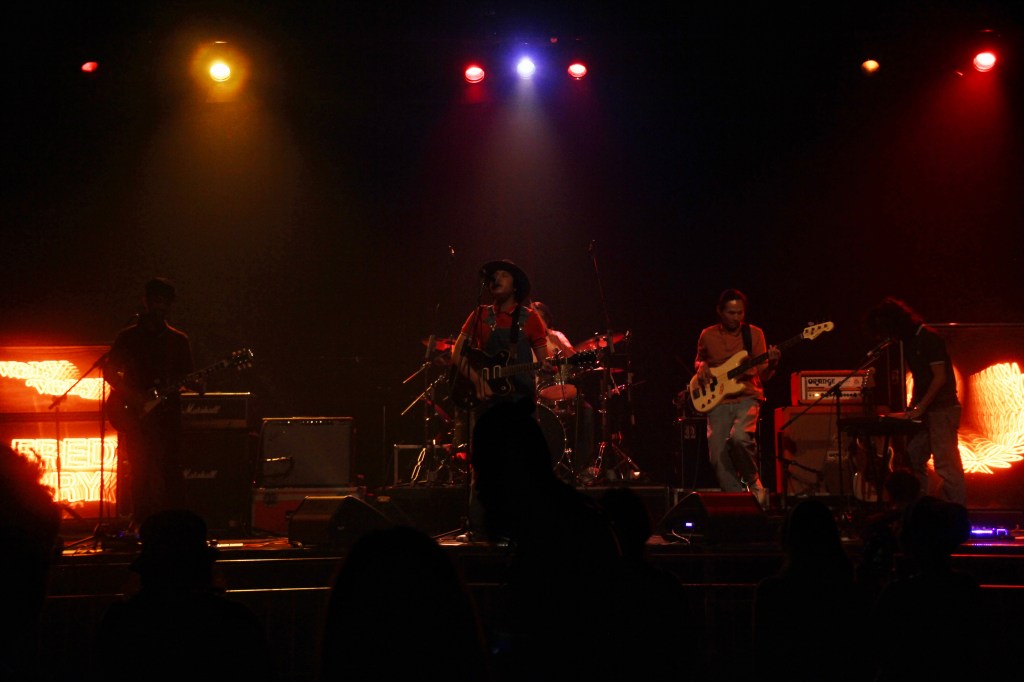
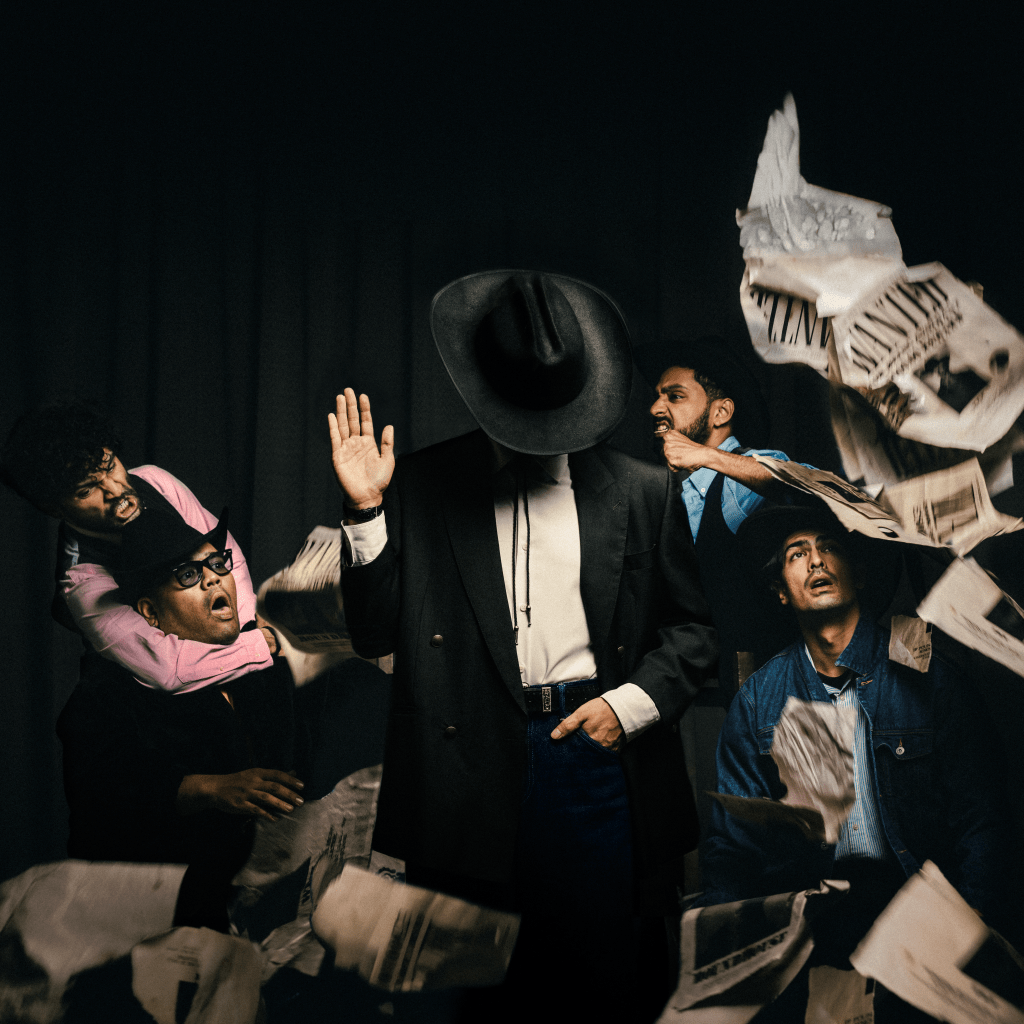
So much has happened since Roadiarc was formed in November 2021. They played 16 shows in 2022. They were crowned as the champion at Volkswagen Fest’s Battle of the Bands. Earlier this year, they were announced as the open-call winner of City Roars! Festival, alongside Awang Samrow and Dani Komari. Then, at the same festival, they played on the same stage as Ipoh indie rockers Muck and the indie rock band making abuzz everywhere, Sweetass. In May, they organised their own gig-cum-art exhibition called “Focus Untuk Capai Kejayaan” — their lead singer and guitarist, Radhi, occasionally refers to it throughout our conversation as the F.U.C.K gig. Now they’re gearing up for their debut album, expected to launch in September.
And yet, the four-piece post-country band still flies under the radar. Their first single, “City of Rome,” is a whirlwind, dynamic rock song that injects country, Americana vibes, specifically through Radhi’s tenacious vocals and his quirky emphasis on words like “fresh chores.” The single, originally titled “The City of Ancient Rome” and released as Radhi’s solo material on Soundcloud, garnered over 1000 streams on Spotify within three weeks. But still, it feels like the single deserves more. In their email trail, Radhi wrote that the song is about the dreadful feeling of being trapped in everyday routine, while knowing that the rich are exploiting the country for their own gain. Its standout lyrics include “Everything that happens in the everyday will happen every time” though a personal favourite of mine is “A forever fight with a forever demon.” It’s memorable, clever and rather depressing.
Their post-country sound may feel alienated within the realm of pop punk and emo sounds currently thriving in the indie scene. Nevertheless, they still feel like a force that you’d hope to see in festivals like Tapau Fest with the mountains of Lenggong as their backdrop or Sunbear Festival in Kuching.
Prior to the formation of Roadiarc, Radhi embarked his solo career in open mics and bars, notably at Merdekarya. Later, he formed the band with Nathanji as Roadiarc’s bassist, along with their previous drummer. They initially started as a punk band, but Radhi soon realised that the band needed more colours. That’s when Thariq and Tuan were invited as their keyboardist and guitarist respectively, and they eventually settled on the art rock, post-country sound.
When they played their first show ever as a band at Merdekarya in January 2022, they were armed with eight to nine songs that Radhi had written alone. “They were all composed on GarageBand and completed without drums, keys, and other stuff,” he said. He added that these songs became blueprints for the rest of the band to craft and refine into their final pieces.
Over two consecutive Zoom calls, I spoke to Radhi, donning his distinctive Cowboy hat and Tuan about their creative process, how DIY spirit can be more challenging than rewarding and their upcoming debut album. Our conversation has been edited for length and clarity.
Roadiarc started as a three-piece punk band and later invited Tuan and Thariq to add more colours to the band. Why didn’t you stay as a punk band after they joined?
Radhi: It’s not that we have issues with punk. Our approach as a band is that if we were to take on a genre, we have to do it justice. We can’t just take on punk and then do it half-heartedly. Personally, I don’t have the vocals for it, or for example, I don’t have the tenacity. So I might as well not ruin the image or the genre of punk, right? I respect genres as a whole, but at the same time, I don’t. Because I think it’s very myopic to just sit in one genre. So when I decided on the post-country sound, I was very lucky that the rest of the boys agreed with me.
The first single “City of Rome” began as an acoustic country song that Radhi wrote in his bedroom. Walk me through on how the song has evolved since then.
Radhi: I wrote the early version of the song in 2019. This is one of those songs I wrote alone that I’ve never finished. This was during the time when the politics in our country was messy and unstable. The first verse talks about power and how we were distracted by our daily lives, so we couldn’t pay attention to the aristocrats and oligarchs who actually control everything we have. When I played it acoustically, I wasn’t really fond of it, I felt that I could do better back then. However, when I played it at several open mics, people actually liked the song.
And when I introduced the song to the band, they liked it too. They liked it enough that they started to chop, dice, split, and put it back together. The final version that you hear is basically two years of breaking it apart and putting it back together. We started jamming it in 2021, and we never stopped working on that song until a couple of months ago. That’s literally what happened. Because we put a lot of pressure on ourselves. I’ve been forcing the boys to practice every week because I want everyone to be tight, basically. Due to the expectation of being a strong live band, we wanted to replicate that energy in the studio version. That’s why we worked so hard on the song, and I guess this is the version where we’re like, “Okay, I think we can’t work on it anymore. If not, we’ll go crazy. Just take it or leave it.”
It took you two years to get the sound right. How do you know when it’s really done?
Radhi: We know it’s done when we know that the more work we put into it, the fewer returns we get, like diminishing returns — it’s a very interesting economical concept. It’s like when you put in more effort, but the difference is not really that huge. So that’s when I realised, “Okay, let’s not waste time because we can’t do anything more.” We were limited by our expertise and our capabilities at that particular moment — money and everything.
Tuan: I also think that we decided we’re done because we have that spark in ourselves where we want to explore a new genre. We’ve played this genre in “City of Rome” and we’ve been through many processes and squeezed our creative juices for the song alone. So at a certain point, we realised that we’ve reached our limits. It’d be a waste to stay put within a sound.
It seems that you prefer to do things differently.
Radhi: I mean, one thing about Roadiarc is that we cannot sit still. You see, there are hundreds of bands in Klang Valley alone. So we’re like “Okay, I think if we do what everybody else is doing, we’ll not be happy with ourselves.” But this has nothing to do with other bands. It’s not our place to say that their music is not good. We’re interested in making music that nobody has heard before. So, our debut album is the first step in that direction.
Tuan, what did you think of the song when Radhi first introduced it to you?
Tuan: To be honest, before “City of Rome” I’ve been listening to a lot of Radhi’s solo material. I would go to his gigs and stream his music on SoundCloud. And I really liked four to five songs he wrote that have country vibes. So when I was invited to co-write the song to fit in the Roadiarc sound, I know we can’t settle with whatever we already had, as in the original sound. We always want to let our creative juices flow.
Do you write songs together?
Radhi: We come up with a lot of structures together. But as of now, we already have songs from my solo materials, and then it’s all about them cutting up and inserting their songwriting or music arrangement. And we’ve decided collectively to continue with that process for the next album. I feel that this allows them to write together with me. I provide the platform, and then they come in. So right now, that’s how we work as Roadiarc.
You released a Live Show EP before your official, studio version. What was the reason behind this decision?
Tuan: The original idea of releasing the live EP was to have our music on Spotify. People have been asking if we have our music on Spotify and unfortunately, we don’t. For us, it was a learning process, maybe similar to artist management. We learned how to distribute our music, settle copyright issues, and everything else. Our friend, Nuril, offered us an opportunity to record live in a studio. Initially, we didn’t have any plans to release it on Spotify right away. However, since we have what could be considered proper live material, we decided to just release it.
So it was all about the learning process.
Radhi: Nuril said, “I think I’m gonna help Roadiarc experience the studio culture and live recording.” It was his initiative to have live sessions for bands. At first, we were supposed to start with one song and later release it on YouTube. But then I thought, why don’t we do three songs together? We are quite confident that we can do it quickly.
Tuan: Yeah, it took almost three hours to record the EP.
Radhi: We intended to use it as a celebration of our one-year anniversary. When we listen to the EP, we know it wasn’t intended to be perfect. It kind of captures where Roadiarc was at that time. We weren’t perfect, and our songs weren’t fully realised yet. Personally, I’m not that excited about them being on Spotify due to the quality of the songs. But as Tuan mentioned, the purpose of it was the learning process.
You recently organised your own gig slash art exhibition ‘Focus Untuk Capai Kejayaan.’ Could you share your experience from the event?
Radhi: The gig was a collective effort from me, The Bungalows Had Eyes and Jay Ivanez. I speak for myself when I say that I’m frustrated by the little circle of indie scene we’re in. We feel like we’re not part of the Malay nor the English music scene. We’re a part of this hobby musicians that bonded over the frustration where we kept being invited for gigs with five people turning up, which is normal in the indie scene. But it has happened too often. And we have big organisers telling other bands, “If you can’t join our gig, then why not start your own?” So these small gigs start mushrooming, as you can see at Angguk Studio. You see all these independent gigs pop up that do it for the sake of it. They think, “It’s okay if nobody shows up, we just want to play music.” But obviously it can’t work like that, because it’s a loss for the venue and everybody else.
So we thought to do it ourselves. We framed it as an art exhibition cause we realised that the market of gig-goers is already limited. What if we try to attract people who are interested in arts? To our surprise, a hundred-plus came up. We’ve been looking to replicate this model sometime in September.
What were the challenges you faced not only as a band but also as the organiser?
Radhi: From an organiser’s perspective, I’d say it’s the people. Anything on paper will work until you put in the human elements. We initially wanted vendors to come in but because of miscommunications and differences in expectations, they pulled out, at the last minute. In terms of getting people, what we realised is that we pride ourselves in reaching out and maintaining relationships who are interested in our stuff. That’s why we started our email trail. We realised to have a personalised communication with people is the approach that works for us as an unknown small band. We’re not Hujan, where we can just share our posters and know the crowd will show up.
Tuan: On the band side, I think it can affect our execution. Out of five of us who played that night, Radhi was the one who pushed the gig since he was one of the organiser’s community. Since Radhi was tired from organising, it affected our execution on stage as it was exhausting. When we discuss together after the show, we know we have to limit our involvement in organising future gigs so we can focus more on our performance.

In your email trail, you mentioned that the purpose of organising your own gig was due to the lack of challenge and progress in performing at gigs on a weekly basis. Considering the challenges you faced in organising and performing simultaneously, do you believe there are alternative solutions to address your frustrations?
Radhi: The problem with us is that we are balancing two things. We want to have a straight trajectory. But at the same time, we know the reality is there will be down and ups. But we want a consistent, upwards trend. My personal take is that it has to be separate. And it has to be done with people who believe in the cause. When we do this band, it needs to be made with people who are not just good at playing music and being together as a band, but who actually believe in this thing, right? We know that right now we’re a hobby band. But the idea is to get out of our day job and do this full-time.
Tuan: For the past year that we’ve been playing music, we realised that we won’t be here if we are completely on our own. There were a lot of processes where we cross paths with others who help us to get to the next level. We need a proper Roadiarc team actually, that’s more than four of us. That’s what we’ve learned from this experience.
When Coldplay announced their show here, or when other international artists come, frustrations are voiced by local bands regarding the lack of similar hype and support for small gigs. As a local band, do you share the same frustration?
Radhi: I think we’re passive about it. If we just expect people to come, then yes we’ll have the same frustration. It’s not that it’s a Malaysian thing — it’s for countries where they’re not so hyped about local art itself. It’s never a question of whether it is good or bad art in Malaysia. If you notice, art has only been looked at by the mainstream as entertainment. I do share the frustrations, but only if we sit here and say, “Okay, this is just how it is. It sucks so I’m just gonna complain about it.” And that’s honestly why we did the gig. Because we don’t want to complain, we don’t want to go to town halls and forums. The thing about Malaysians is we love to discuss. But if you dive down to what they talk about, they only are very expressive about the issue. They only like to paint a very good picture and give you anecdotal evidence, but their solutions never go beyond “the government must support and fund our art.”
Tuan: They only talk lah.
Radhi: This frustration happens to all other upcoming artists. It’s because it boils down to whether you can capture and grow your audience by this. So for Roadiarc, that’s our challenge and I guess it’s a challenge for the entirety of our career.
Tuan: To be fair, the international acts really kickstart the journey by appreciating their fanbase. Personally, I think they deserve it because when they come here, they bring something to the table. That is something that small bands should strive for. Why not take it from another angle and get inspired by it?
How would you describe your current fans and audience?
Radhi: We’ve been told by people that Roadiarc won’t have a huge following but we will have a cult following. So I guess it’s true. In May, we did one gig every weekend, which was a mistake on our part, and also a learning journey for all of us. We managed to capture the attention of a few people who have decided that they will show up for each gig throughout May.
For Gig Campak Vol. 2 organised by Kumandang Zine, we had a few unsold tickets. So what we did was, we told people that they can pay what they want for the tickets, even if they want it for free. Because if we were gonna sell it at whatever price that anyone is putting, there’s nothing interesting about it. In the end, nobody took the ticket for free. Everyone paid something, so people are willing to pay to see us. There were people who paid RM50 for a ticket when they could’ve taken it for free. I was like okay, these people are crazy. They are interested in our music.
Tuan: For me, it’s more about the byproduct. The process of making art is just the four of us. We are the first listeners of our music. So before we share our music with the people, we need to be satisfied with it first. And we ended up finding fans who enjoy our music as much as we enjoy making them.
You said that performing every week was a mistake on your part. Can you elaborate?
Radhi: We are a fresh band who don’t have a huge following at all. So there are only around 20-50 people that we can invite and be assured that they will come out to our gig. And so what do we do with this number of people? Do we split them across gigs? Because they’re not going to come for each gig, right? We have that limited social capital that will attract people to come to our gigs. This has affected ticket sales too. So every time we play at gigs, it’s more like a jam session with a couple of friends.
And we also realised that the organisers, except for Sofea of Kumandang Zine, are maybe not that active in pushing out the gigs. But it’s not to say it was entirely their fault. It’s a collective responsibility. But there’s a limitation to how many people we can pull in. Yes, the small organisers want to provide opportunities for small bands, but at the same time, small bands don’t have a lot of following. In this situation, organisers should be a bit more active than just providing the infrastructure, they should do more of the marketing as well. And when we don’t repeat those mistakes for our gig, the results show that you can’t just provide the infrastructure, you can’t just provide the venue, you have to do outreach. It’s just reality.
Tuan: And from our side, it was our mistake too. In Roadiarc, we go through phases as a band. Previously, we had a phase where we want to play as many shows, to share our music with as many people as we could. When we were offered to play at many gigs in May, we were still in that phase. But at the same time, we realised “Oh, Roadiarc should already be in the next phase.” Instead of accepting as many gigs as possible, we should be more systematic in booking our shows, and choose the impactful ones. That transition phase is where we had that dilemma.
Radhi: I agree that we overbooked ourselves. It creates this lack of exclusiveness because if we keep playing the same songs then what else can we offer to the crowd, especially those who come to our gigs often?
Were you already having that dilemma when you played at the City Roars! Festival in April?
Radhi: I will say it started there. We didn’t realise it until we got off the stage. We realised that our old phase has passed because it occurred to us that we were performing with the big bands. We were like, “Wait a minute, I think we’re not just some normal indie band. I think we actually have something to offer.” We knew that we need to start our new phase.
Tuan: Before performing for City Roars! Festival, we knew it was a once-in-a-lifetime opportunity. But after performing, we felt the shift in what we wanted to achieve next. We started to aim for more than just making music, but also thinking about the commercialisation aspects of music.
The email trail is an interesting approach to connect with fans. It feels personal and closer to your listeners than social media. Was that your intention?
Radhi: I actually had my own email trail and blog for my solo act before I did Roadiarc. I was inspired by international acts such as Pup, Pinegrove and also Radiohead who do that a lot especially when they were really active back then. I wrote for the potential fans and initially I had, like, three people who signed up. And later it became a community thing.
With Roadiarc, we use it as a chance to reach out to people who are actually interested in us. I mean, social media is great. But I believe social media is to capture the people who are interested in the first go — not the ones who are really curious. So this is how we try and keep people who are interested in our Roadiarc. I write everything in the newsletter, from politics, and economy to the music scene. But it was also a chance for me to show people what Roadiarc is all about internally.
What can we expect from your debut album?
Radhi: Our debut album has nine songs, and eight of them were written during my solo days. There’s one song that we wrote together as a band. The album is gonna be art rock but laced with country vibes, it definitely has an Americana element. But we made it clear that we don’t want every song to sound the same. They may have similar vibes, but they won’t sound the same.
The songs came from that lonely and sorrowful time of our lives during COVID-19. Personally, it was the time I lost all my grandparents due to COVID-19 or the stress of it. Writing the songs was my coping mechanism back in the day, but now it has evolved into a bunch of songs that all four of us have poured our frustrations into.
Tuan: It’s a collective arrangement of music. When you listen to it, you can spot the distinct element from each of us but they blend well. They will complement and create synergy, along with the heavy emotions Radhi mentioned.
Stream/buy “City of Rome” on Spotify / Bandcamp / Apple Music

 noisy headspace
Leave a comment