
BY NUSRA ROZELY
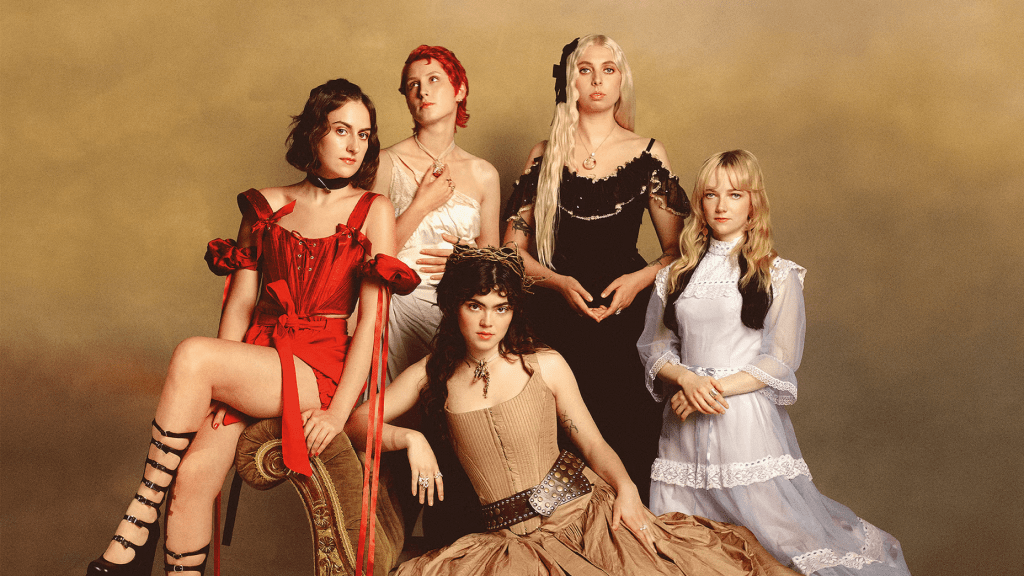
Sometime in April last year, a post by NME came up on my Instagram feed announcing the debut of the five-piece London-based group, The Last Dinner Party, along with their first single. Their distinct vintage Victorian-meets-medieval style seemed thorough and deliberate; it’s the first thing you’d notice about them, especially amidst the ongoing dark academia fanfare online then. I gave the single, titled “Nothing Matters” a listen, anticipating huge orchestral arrangements that fell in line with their niche aesthetic, but was shocked to hear a solid indie pop-rock tune with production that sounded like they were years into the game.
I couldn’t quite piece together who, or what they were, apart from a few small-time articles online. All I gathered was that they met training at the Guildhall School in London (one of the world’s top music & drama schools), and how they’ve supposedly conquered the city’s underground gig scene in the past couple of years, which begs the question of their instant rise to the top. In an era where imagery trumps artistry, was it their hyper-present, desirable divine feminine aesthetic, or were they genuinely talented artists?
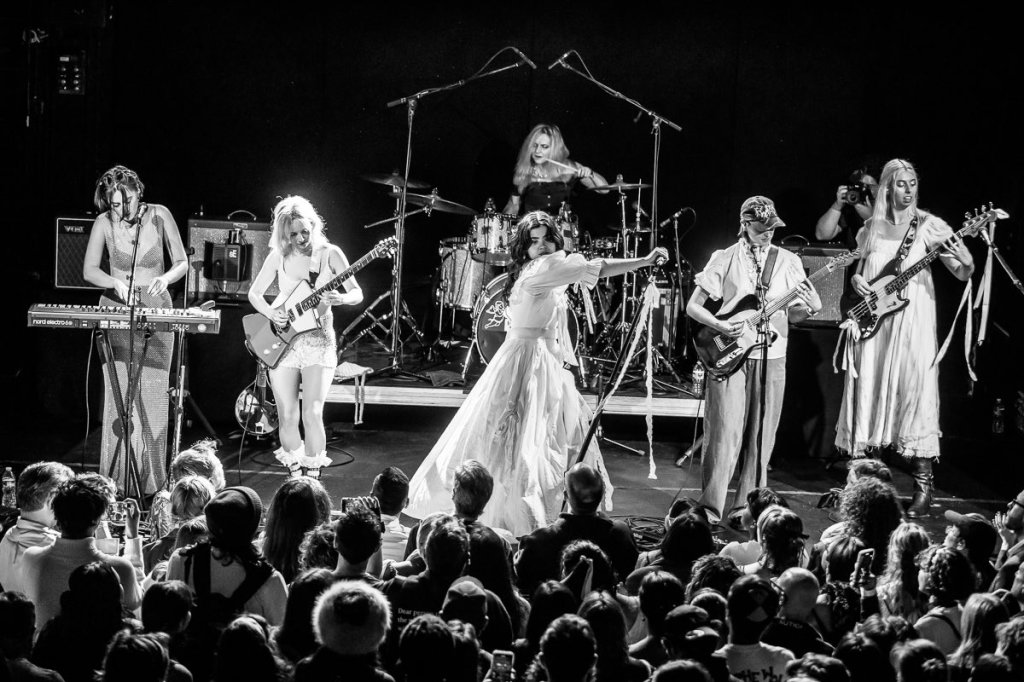
The Last Dinner Party quickly gained traction after the release of “Nothing Matters” and were cordially invited to the UK’s most celebrated music festivals of the season, including Glastonbury and Truck Festival, where I had the opportunity to see them live. Frontwoman Abigail Morris energetically yet gracefully pranced across the stage with the poise of an Elizabethan noblewoman frolicking through fields, hand-in-hand with her inner child. The crowd were receptive, enchanted by the band’s allure, even though many festivalgoers had yet to hear of them, and still only had two singles to their name. The second single was released just in time for the festival season. The uptempo baroque-pop “Sinner” is infused with classic-rock-influenced piano and guitar, and vocals roaming the liminal space between cheering and chanting.
Their debut album, Prelude to Ecstasy, was released on the second day of February 2024 under major label Island Records. Despite being in their twenties, the 12-track album feels like a memoir from the last century — a locked, leatherbound diary, dusty with age, unearthed from an abandoned house. The album opens with the title track, ushered in by quaint yet playful horns and brass section, then thundering in with a full orchestra that you’d picture filling a grand opera house, satisfying my initial impressions of them. The album is drenched in antique, esoteric imagery surrounding themes of desire and femininity.
Their latest single “Caesar on a TV Screen” alludes to Roman emperor Julius Caesar, whose life story was famously adapted for the stage by William Shakespeare. Morris straightforwardly envisions the power and ease she would possess by presenting in a stereotypically masculine fashion, “When I put on that suit, I don’t have to stay mute / I can talk all the time, ‘cause my shoulders are wide,” referring to the traditional masculine image of a fighter, protector — a Roman emperor. These ideas evolve into gender envy and yearning in “Beautiful Boy”, lamenting the perpetual fear women live in. The desire to be a “beautiful boy” is repeated like a mantra in the song’s chorus, in a disturbingly familiar and comforting way, like hugging your knees, rocking on the floor trying to soothe and stop yourself from crying.
Prelude to Ecstasy clearly illustrates the marrying of their sonic and aesthetic vision. Whilst still performing in the London underground gig scene, The Last Dinner Party had already been known for their antique style, with candles lining the stage and red wine in hand; an explosion of practically anything Victorian, medieval, gothic, and Rococo (?). The band even explained how the inspiration for their name came from the idea of a “debauched dinner party”, with people coming together for a bacchanalia — wild parties filled with drunkenness, lust, passion and desire. Their lyrics reference Shakespeare, Abrahamic locations and religious language. Keyboardist Aurora Nishevci wrote and sang “Gjuha” in Albanian, her family’s native language. The 1.5-minute-long track, which translates to “tongue” is a haunting meditation on the disconnect felt by a child of the diaspora with her mother tongue and culture. It also features an eerie melody line accompanied by a lone mandolin and ritual-like harmonies, reminiscent of the Weird Sisters in Shakespeare’s Tragedy of Macbeth.
People have had their fair share of scepticism since the five-piece entered the mainstream scene, with claims that they are industry plants being the most persistent. All of these claims were contributed by several observations: Their debut single and album were released under a major label with virtually no traces of them online, they opened for The Rolling Stones in Hyde Park in their first year of performing in London’s live circuit, on top of their privileged upbringings (Morris attended Bedales School, which costs up to £43,000 a year).
Industry plants are usually viewed negatively because they are mainly cash-grab opportunity projects by big labels who merely develop them for more money, taking up the spaces and opportunities for smaller artists who don’t have the same privilege and financial support. Many people have quickly critiqued their lack of transparency, while others argue they don’t owe it to anyone. I personally believe that industry plants do occupy the space that could be used to develop smaller-scale musicians and that the persisting issue of industry plants only re-emphasises the imagery triumphs artistry issue, taking away from real musicians with genuine messages and art.
However, I also do believe that in the capitalist society we live in, this issue won’t cease to exist anytime soon. If industry plants were to be industry plants, singing lyrics with socialist implications like “Red Scare” and “Leningrad” whilst also being privately educated, they then have a responsibility to acknowledge their privilege and use their platform to speak on current issues instead of using certain words to add depth to their image.
Despite the industry plant allegations, The Last Dinner Party’s meticulously crafted image has brought them success. They have already found themselves booked for the biggest names in 2024’s festival season, including Reading and Leeds Festival and Coachella, with their fanbase only growing by the day. The band have successfully reclaimed feminine styles from eras notorious for their unjust, less-than-human attitudes and treatment of women. They are instead singing candidly of their carnal desires, pride in gender nonconformity, and of men as superfluous beings. Fans seem to admire the band’s ability to poetically depict the universal adversity of women in an era where they are past the self-awareness of living in a man’s world. They are now furious, lamenting on their shared experiences and traumas, and how they can break the generational curse that befell them. Their descriptive lyricism evokes a sense of nostalgia and yearning, on top of their electrifyingly engaging showmanship. If the allegations are true, The Last Dinner Party undoubtedly possesses the talent and charm to convey meaningful art that transcends the gravity of their privilege. They croon of the joy and suffering of womanhood and femininity and, above all, the struggles that make us human.
Nusra Rozely is a 24-year-old actor and writer, recently graduated from the MA Acting program at the Liverpool Institute for Performing Arts. With a background in writing for publications like The Star’s “stuff@school,” she has returned to writing professionally after a year’s worth of master’s research. Her works cover various topics, mainly focusing on pop culture, gender dynamics and recently a short play on fangirlism.
 noisy headspace
Leave a comment