

Moments rarely feel historic when you’re living in them. When they happen right before your eyes, it’s easy to dismiss them as mere fleeting, airy images that will soon turn into mundane memories stored deep inside your brain. But when Tangsestra was announced, it was immediately expected to be a historic moment. Six post-rock bands sharing one stage — though at least two acts lean more towards post-hardcore, and one of the best bands today doesn’t even consider themselves part of the genre — with an orchestra. An orchestra! A superb ensemble that appeared out of the blue. In a music scene where the spectrum ranges from big, bloated, mostly all-hype-no-substance festivals to small gigs with at most 50 attendees, this idea felt like a fever dream. Is this a little treat we get for being… nice? A project of this magnitude comes so rarely that its existence needed some sort of justification. Are we celebrating an anniversary? A very important person’s birthday? What exactly have we done to deserve this?
But the answers don’t matter. It’s happening. It’s legitimately exciting, cathartic even. Tangsestra is organised by Tangsirama, a community-first collective that has previously organised free concerts with headliners including OAG, Margasatwa, The Impatient Sisters and more. The initial venue choice was, of course, Rumah Tangsi, a yellow mansion-style event space that has existed for over 119 years. But I thought it was an odd venue choice. Have we underestimated the appeal of bands like Dirgahayu and Kias. (formerly known as Kias Fansuri) playing with an orchestra? Even when I tried to imagine the charm of the performers playing in the intimate, 300-attendees-at-most space of Rumah Tangsi… it just doesn’t work. Are we all supposed to shudder a few centimetres away from one another, accidentally sniffing each other’s sweat, fumbling to watch Dirgahayu blast the mighty “Bahawasa-nya” in our faces?
I can only assume the organisers came to their senses when they saw their Google Form overwhelmed with hundreds of people eager to witness history in the making. So, several days before the show, a new venue was announced: Panggung Anniversary, right in the heart of Perdana Botanical Gardens. From a small mansion to a ’60s-born, now modernised amphitheatre, this sudden, apt decision to change the venue skyrocketed excitement and RSVPs everywhere.
The theatre was so far inside the garden that when you arrived after a ten-minute walk in the dark, it felt like discovering a secret, hidden society, all waiting for the liturgy to begin. Panggung Anniversary has an aerodynamic, curvature-shaped canopy that protected us from the heavy rain, but still, the unfortunate latecomers were half-drenched. It had been raining since 4:00 PM, but the moment we saw —Seru carrying their instruments on stage, we could all catch our breath, knowing that, yes, we were watching a post-rock concert in the rain. Too cool, too freaking cool.
For a band that debuted their album last year, —Seru performed a gorgeous set. When the poem in the middle of “Sambung Nyawa” was recited, I started to wonder if the birds at the nearby KL Bird Park or the butterflies just walking distance from the venue were also surrendering to the magical moment. There is no way we are the only creatures lucky enough to witness the majesty of it all.

Meanwhile, Ufuk Raya was the clear unofficial winner of the night, supported by the fact that their riskless, delicate sound was made for a night like this. “I’m witnessing history, I think,” I chanted inside my head. Their lullabies of soft guitars and intensifying drums harmonised with the evening. During “Indah, Selamanya” the strings from the Tuan Isa Ismail-led orchestra, which were almost hidden during —Seru’s set, came back to life. I couldn’t stop thanking the rain. Like, thanks for being the main unpaid actor of the night. If you had told me Ufuk Raya communicated with Mother Nature herself to make their set the most majestic of the night, I would’ve believed you.
The audience that night also fulfilled their roles, a much-needed accessory that complemented the show. Black was the unofficial dress code that everybody somewhat happily obliged to, including me. Most of us didn’t dress up for a Dewan Filharmonik PETRONAS type of show. Instead, there were band shirts, jeans and sneakers — the usual suspects. Two kids sat near me, their father wearing a “Making Hip Hop A Threat Again” shirt. A woman wrapped herself in a keffiyeh to keep warm. When Ufuk Raya closed their set, a guy behind me — presumably in his 30s — got up to stretch his back aggressively. His facial expression wrinkled, noting that it was a much-needed stretch. I’m probably a decade younger than him, but… same, dude.
When Kias. took the stage, though, I was no longer thinking about the birds and the butterflies. I was thinking about the garden nymphs, the towering trees, the night dew drops, all inside the botanical garden. It wasn’t every day their nights were blanketed by Kias.’ vocalist Khairul’s guttural screams, hearing him wail “Dalam diam dia menangis / Tiada lagi suara / Yang tinggal hanya duka derita.” Most people barely moved, shadowy figures all sitting still as if we were Medusa-d, and later taking long, deep breaths after every song.

The idea of an orchestra playing on stage with a post-hardcore band ingrains a mental note in our heads that the tradition of circle pits and wall of deaths wouldn’t be “polite” enough for such a show. And so during Kias.’ set, you had a bunch of moshers sitting nearer to the stage, their legs folded and headbanging while their bodies stood still, all while making sure they wouldn’t cross the line that the organizer had taped. “An invisible wall,” the emcee joked. It felt like watching a performance art. Entertaining to see, though you’d struggle to make sense of it.
Earlier, I almost missed the show because of the heavy rain. Post-nap, I contemplated whether it was worth the RM29 Grab ride for something that would be organized again and perhaps summoned its copycats. But I wanted to see Dirgahayu, so bad. The last time I saw these beasts was at City Roars! Festival 2023. In their true nature, the not-so-new lineup of Dirgahayu performed as if its sole intention was to make you envy their talents. I still remember Tiong Faizal drumming to the brink of exhaustion. There was little to no eye contact with the audience. The only form of communication was their sound expressing “Yes, we’re here to tear the stage apart.”
This graphic memory of my first time watching Dirgahayu, coexisting with the grandeur of an orchestra, was what dragged my feet through the heavy rain, my white shoes drenched in mud, my face soaking with sweat as I arrived at the Perdana Botanical Gardens. Sure, I was RM29 poorer. But all I wanted was for this illusion to come true.
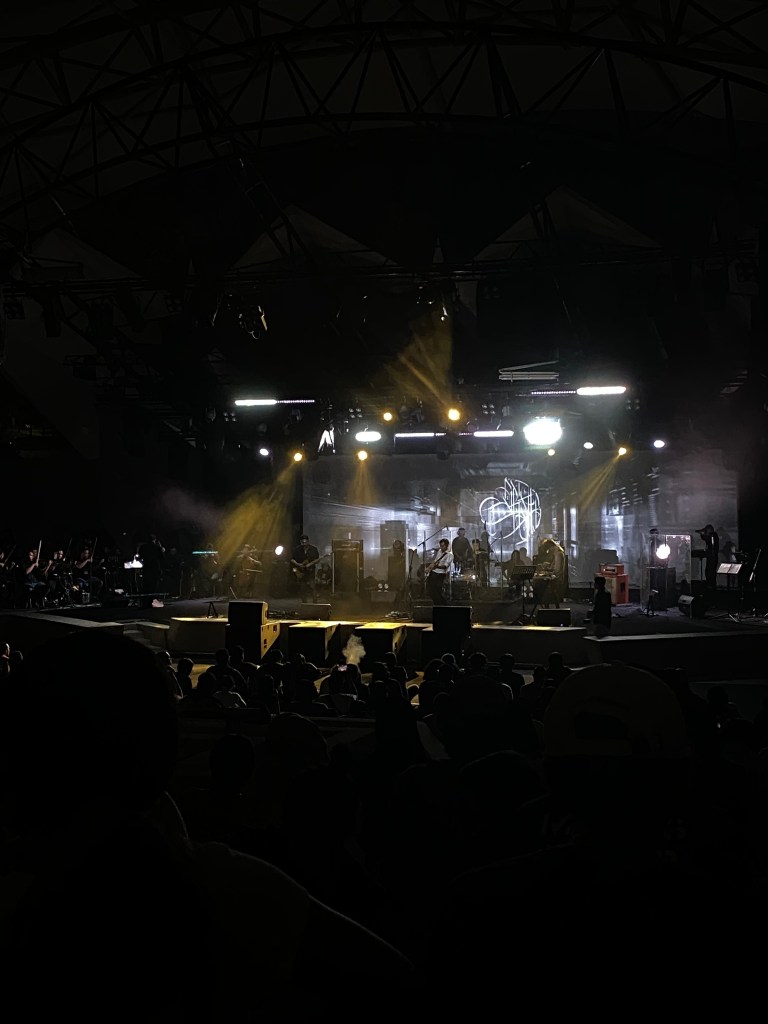
But it was that very illusion that was destroyed upon the first Dirgahayu note that struck the stage. A gradual anti-climax that takes too long for the reality to hit you. Their roaring guitars were chastening. I could see them bending their back, unleashing their robust sound, but it was either drowned out by the “Ooohs” and “Aaahs” of The Sound Collective choir or seemingly lumped together to produce a displeasing noise. What happened to the elegantly structured sound design that we had during the Ufuk Raya set? It was like watching a horror movie on mute. The inevitable, much-anticipated jump scares arrived with no excitement. Give me the shock factor. Give me guitars that could leave my ears ringing in pain. I’m simply asking: How do you make a timid mouse out of a monstrous band like Dirgahayu?
Some of us rushed to Twitter; you were either stunned by the set or let down by the expectations of what could have been. Most argued that we shouldn’t complain because it’s a free show. I’d say that’s the wrong take to have. If Tangsirama had curated a different, dare I say, more mainstream lineup, removing the post-rock aesthetic appeal, many would be the first ones in line to criticize government-supported free shows. So just because the government gleefully supports an independent concert that coincidentally fits your taste in music, with a sprinkle of orchestra, bow-tied with a choir on the side, therefore its flaws should be excused from any criticism? Got it.
For the rest of the night, the weight of the collective became more of a burden to watch. More and more underwhelming pressure started to plunge in as I watched Tres Empre on stage. The moshers had more freedom, though they hesitated to engage in full-force head-speed circle pits. For the rest of us, it felt like we were in a world behind. The muddy sound system was like a flicker of sunbeams brightly on my face; everywhere I moved, it bothered me. Polarizing reactions drowned my timeline while the emcee was still dwelling on the idea that this was the greatest show ever. I don’t blame him at all because, on paper, it still was.
On the ground, though, that illusion had already mixed itself into a disappointing reality. I texted my friend to validate this annoyance. He, who sat several rows in front of me, replied instantly. “Memang makin drop quality sound dia,” he said. We continued our rants, while the fleeting sound of Damn Dirty Apes slipped thin through the air. I decided to leave early.
Years later, we’ll still remember Tangsestra for its historic ambitions. Six post-rock bands performed with an orchestra in a free show right in the heart of Kuala Lumpur. That’s the headline you’ll read years from now, or perhaps sooner, as copycats try to replicate the event’s success, having seen the appeal that drew around 1,000 people to Perdana Botanical Gardens. The dream of Tangsestra was precisely that: an ambition to make history, even if the reality fell short.
But do I want to remain bitter about it? Instead, I want to remember the guy at the front who, while sitting down, took off his hair tie, releasing his hair from a tight ponytail to headbang, as if that was the maximum length he could do to truly relish the show. Or some dudes near the stage, seemingly strangers, nodding to one another towards the end of Kias’ set, signalling “Yeah, let’s fucking do this!” giving each other permission to go wild. I’ll remember the hair-raising moments when Ufuk Raya’s guitars echoed in the park. Or that very brief second of excitement I had when Dirgahayu walked on stage, their logo appeared on the screen. If to make people stay in these incredible, sort of life-changing, transient moments was the purest intention of Tangsestra, then that ambition did come true.
Farhira Farudin is a Kuala Lumpur-based writer, whose work has appeared in Malaysiakini, MalaysiaNow, Eksentrika and others. She is the founder of Noisy Headspace.


 noisy headspace
Leave a comment