

BY AMIR KARIMULLAH
Once we get over our supposed solipsism, it should be clear that the structural issues in the local music scene are not too unidentical to the rest of the world. Lack of funding and structural support is common even in Britain or the States, no matter how much Charli XCX makes Taylor Swift feel about being a brat. Survivorship bias needs not time to stew within the consciousnesses of you and I — if you’re a struggling musician in little Kuala Lumpur, you’re not special. And usually, that is fine if you are self-aware about it. Being a musician is no easy feat in this day and age of content farms and overhyped artificial intelligence, props to those doing it full-time and most importantly…
It is what it is.
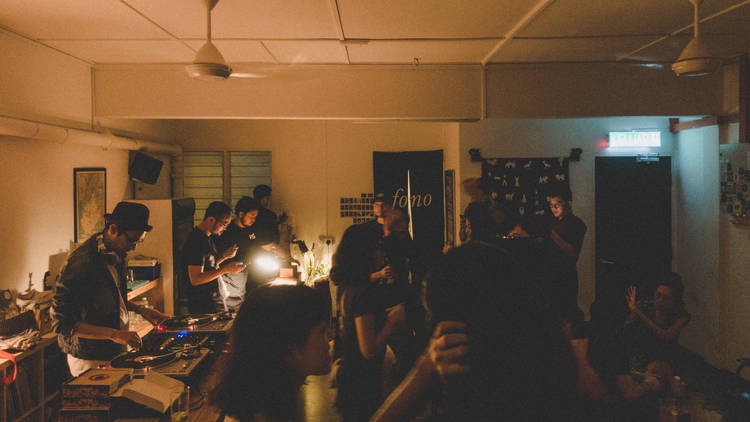
This reality permeates thickly throughout the very bottom of the music scene – open mics. Think Omegle for music instead of the familiar horrors of the Internet, where you find yourself at a bar or a café unglued to your seat serenaded by some dude with an acoustic guitar whose performance ranges from grating outsider music to another cover of the Fake Plastic Trees. It’s your decision on which are the ‘best’ and ‘worst’ ends of that spectrum, and you are free to leg if it gets too much since there is an absence of elephant glue on your seat.
At the behest of a friend a decade ago, I began frequenting several spots throughout Kuala Lumpur because we had little money to spare for entertainment and there’s very little desirable third spaces to go to (current kicking and alive open mics are like Jalan Dalam’s monthly shows and Kumandang Zine’s Lepak Akustik) and eventually I would recognise the frequent and interesting voices in the open mic scene. Familiar names to me were Shaneil Devaser (firebrand dadrock), Azizbodoh (outsider music extraordinaire) and Sounds of Kites (baritone folkman). They were the saving grace amidst swaths of uninspiring blues or pop rock acts, understandable since the main constituents of the open mic talent pool are feckless hobbyists.
But none of them could compete with Niko Rei Shua (sometimes known as “Nicholas Sia”).
I truly believe that he is a once-in-a-lifetime talent in Malaysia, a versatile voice that is both difficult and weird, pushing the limits of songwriting. He unashamedly frequents any drink hole, gentrified F&B establishment, parking lot or five-foot walkway so long he is able to unleash his brand of freeform jazz anti-folk onto unsuspecting spectators. While a common songwriting motive outside our borders, Niko frequently wails in his androgenous voice over jazz chords and solos about whatever that depresses him. Reactions from the crowd are rarely muted, often generating pure confusion, surprising hype or murmuration of snide and derision. Being such a divisive force of nature is a testament to his innovation and originality as a one-man act. For myself, it was only after the fourth time I saw him perform a number on his white Strat singing about a “New Disease” (read: Covid-19) that realise it is not despite his Kurt Cobain-esque scrappy yelling, contorted facial expressions, nuclear stage presence that he is a great artist and performance, but because of it.
One might argue he hasn’t made it far because he sings in English or that he doesn’t do enough lovey-dovey romantic songs. Or maybe he’s just too weird. Or maybe he hasn’t adopted Az Samad’s music marketing tips of the day. My argument here is that while Niko is blessed with singer-songwriting talent similar to Daniel Johnston, Phil Elverum, Jeff Mangum and Mark Kozelek exemplified in his songs such as “Why Does My Life Have to Be so Sad?”, “Once Upon a Hit & Run”, “When Will Your Life Begin?”, he also bears a huge resemblance to the conducts and habits of many self-defeating auteurs.
I have been lucky to converse with him, just enough to get an insight of the man himself. Once you get past his sardonic tone of speaking, Niko comes off as sensitive, fragile and in a constant battle of getting grips with himself in terms of his identity down to plainly what he wants out of his life, which he once exclaimed to be “one of the experiences of all time”. Beneath all that irony lies a person who finds comfort in the challenging songs and breath-demanding Wesley Willis-esque words he sings, whether he admits it or not.
While he spent most of his musical journey as a solo artist, he had fronted the now-defunct Tenkills and currently The Bungalows Had Eyes, both heavily featuring his signature vocals. In both acts, he continues to behave in a stop-start manner which hinders the progress of both bands. While it appears that he functions better alone, one would be fair to suspect that it’s a self-fulfilling prophecy type of situation. Niko once stated he is completely comfortable gaining fame or notoriety in decades time, taking inspiration from outsider music acts like Jandek who obtained a newfound cult following thanks to the YouTube algorithm. Hence, he seemingly deliberately avoids promoting his own work, to which this essay is trying to frustrate that effort.
An innovative local talent that you could be proud of among the likes of Kamal Sabran and Dhan Illiani, Niko Rei Shua is a local talent worth exploring and supporting in spite of the lack of funds and structural support from our dear Unity Government, even if Niko is a little late in feeling like he deserves it. At this point, anyone’s enthusiasm towards his work will keep him creating more left-field material that he could use to dumbfound poor souls such as myself once upon a time.
But what does this mean for the rest of the open mic scene? Should middling acts realise that their musical efforts amount to nothing but their own “spiritual masturbation” and just give up?
Of course, since Malaysia is becoming an aged nation, I personally prefer these old farts to give up the ghost and make way for young blood to fill up the stages and floors with fresh music. But that would be a reactionary move and I am no politician. All musicians – mainstream, underground and open micers – should make a concerted effort to expose themselves to the songs and live performances of Niko Rei Shua so they can learn a thing or two about rimming at the envelope of musical boundaries. Local music desperately needs more experimentation and willingness to challenge themselves and audiences to form its own identity beyond “Malaysia’s The Strokes” (so many local bands), “Malaysia’s Tool” (Sabda Alam), “Malaysia’s Tame Impala” (Golden Mammoth) or “The Next Hujan” (Masdo et. al).
Or they won’t, because the focus of musicians in this enterprising nation are the top ten tips and tricks on how to promote your music, how to be a band, how to gain a following online. The day when WritersDaily shifts their content towards music itself will be when the majority of their audiences are educated masses and no longer just bands and musicians, and what a glorious day that would be for Malaysia and her music scene.
Amir Karimullah, hailing from Kajang, is a passionate individual with a deep appreciation for local music. Despite his love for his homeland, he often feels frustrated that Malaysia remains mid in various aspects. Known for being opinionated, he frequently voices his thoughts on various topics – usually in his head.


 noisy headspace
Leave a comment