

When Rondivu was launched in 2020, it carried an underdog, somewhat nostalgic spirit that was hard to define: it covered the independent music scene in a mainstream newspaper, written by an Utusan journalist who considered himself an outsider of the scene. Ku Syafiq Ku Fozi worked on Rondivu as a one-man show, offering criticisms and in-depth interviews with bands and key-figures, exploring issues that had long existed but rarely discussed on a prominent platform. Rondivu was published in Utusan’s Mingguan Malaysia every Sunday and was initially accessible for free on the Utusan website, and you could also get the newspaper version for RM2 — if you still knew where to find a newspaper these days. Its inception coincided with a period when people were nostalgic for the golden era of Joe Kidd’s Blasting Concept, a music column in The Sun during the ’90s, or at least for those who longed for a modern standard of excellent music journalism, whatever that might mean.
Rondivu came to my attention sometime in 2021 when a random tweet praised Utusan for being the only (mainstream) media extensively covering the underground music scene, pushing bands into the limelight as if they were already somebody. In reality, some of the bands covered in the earliest days of Rondivu were still new. It was easy for bands that debuted around the same time as Rondivu to get Syafiq’s attention; Hacktick!, Pasca Sini and A. Limin, to name a few. These new, fresh faces were featured on a full page of Mingguan Malaysia or had their songs mentioned in his year-end lists, printed next to gossip about celebrities fluctuating marriage and their cookie-cutter, coy responses. Either way, Syafiq gave these bands a new goal to check off their bucket list, whereas digital media couldn’t provide the same excitement. In a time when print music magazines are not only dead but the chances of their resurrection invite sneers from non-believers, Rondivu had unintentionally emerged as a focal point of local music journalism.
Syafiq also enjoyed a freedom that most mainstream journalists don’t: for Rondivu, he had the liberty of an independent journalist with a mainstream platform. His work for Rondivu was free from the micromanaging editors; there was barely anyone questioning his subject choices, that would typical evoke rejection from senior, bitter editors who refused to understand modern Malaysian music beyond gloating over M. Nasir’s songwriting brilliance. He was free to choose any subject from any angle, write to any word count as long as it fit the tabloid-sized Mingguan Malaysia, and free from the brutal verbal editing that most journalists are accustomed to. Try pitching full-page coverage of a new band like Roadiarc to a struggling mainstream newspaper. You wouldn’t succeed, but Syafiq did. For Malaysian journalists, this freedom extends beyond what you could explore in your work; it’s a luxury that most of us can only fantasize about in our best, most forgettable dreams. (Would his music writing have been more refined had he worked closely with a great editor? I guess we’ll never know.)
Not all bands covered by Rondivu were among the greatest or ended up being the biggest stars, though. But it was a relief to know that there was someone who cared enough about the independent music scene — often overshadowed by Anugerah Juara Lagu pop stars and Indonesia’s exports of trite melancholy singer-songwriters — that he was willing to write about them. As Jessica Hopper, author of The First Collection of Criticism by a Living Female Rock Critic, puts it: “A negative and a positive review are fundamentally born out of the same place of truly giving a shit.” Rondivu paved the way for more conversations, becoming a surprising beacon for those skeptical about the current state of music journalism. For us writers, Rondivu was on the frontline, tackling criticism about our shortcomings. For the musicians, Rondivu was on top of the pyramid they’d climb up to get Syafiq’s attention. The column endeavored to balance its writing according to its predecessors’ call for sharper, Lester Bangs-ish music criticism, while attempting to keep its language simpler to Utusan’s audience. Rondivu was the balm that made music criticism easier to articulate, addressing questionable practices within the independent scene when most of them have become the default.
Over time, Syafiq’s voice became more critical. His tone shifted from simply giving platforms to critiquing the scene. Syafiq noted that this change was largely influenced by his interview with Zim Ahmadi and Zhafirin Zulfikli, the hosts of the weekly live show Gedegang! and operators of their respective music sites, Awful Track Record and bawahtanahrasmi. This direction led him to become a scene-appointed expert in the subject matter, appearing on podcasts, in interviews, and as a guest at ML Studios, an attempt to reach a wider audience. Sure, his criticism still circulates within the safer, harmless territories, yet even on the surface, he still twists the knife deep enough to provoke negative reactions towards his writings.

The thing is, our music scene lacks important voices, and the significant ones like Rondivu are either disregarded by its godfathers, scrutinised by those who don’t read past the headlines or championed by those aspiring to be The Next Important Voices. It was natural for the public to place Rondivu on a high pedestal, to regard Syafiq as a saviour of music journalism or at least the face of it. It also became easier for people to criticise him for his limited coverage, expecting him to cover every release, even for music beyond his taste; Rondivu glorifies pop punk, and people expect more hardcore coverage. Rondivu enjoys mainstream hip hop, while some rising rappers expect instant press from the column. The more Syafiq criticises, the more people demand him to prove that he is a true saviour of the scene — a label they had cynically plastered onto him or anyone else who dares to criticise. Everyone had unattainable standards for a one-man project in a scene where media outlets are shorthanded and the bands are rapidly multiplying.
Last week, to celebrate the fourth anniversary of Rondivu, Ku Syafiq hosted a free gig featuring his four favourite bands: Glistening Redchair, Motherwit, Pasca Sini and Dewataraya. During the performances, Syafiq divided his time between welcoming guests and moshing with his friends. Snacks were provided for free, donation piggy banks were placed on tables and familiar faces came and went.
What he didn’t reveal was that it was a farewell party for Rondivu.
The shocking announcement came after the exhilarating set by Pasca Sini. Syafiq took the stage casually, thanking the audience for celebrating Rondivu. Then, he finally made the announcement: the end of Rondivu. The setting was odd. We were all there for what was supposed to be a milestone, but instead, we ended up attending a funeral for the most important column in today’s music scene. We sang “Happy Birthday” to Rondivu, and a large, frosty cake was brought on stage — all against the bitter reality that it was Rondivu’s final birthday.
Syafiq attempted to end Rondivu last year. He explained that due to juggling multiple roles, Rondivu could no longer continue as a weekly column. The situation worsened when his mental health deteriorated, and several weeks of Rondivu were missed. This year, shutting down Rondivu was an apparent and a seemingly liberating decision for him. In his official announcement, Syafiq stated that the decision was made with “a sound, rational and clear mind.” Given his responsibilities with Relevan, the news portal focusing on education, finance, health and career, Syafiq acknowledged that “Rondivu is the obvious choice to let go of.”
Several weeks before the news broke, I sat down for an interview with Syafiq, for what ended up as the final article of Rondivu. I wasn’t aware of this. The interview didn’t include the parts where Ku Syafiq and I were foolishly patting our backs, reminiscing the joy of writing about the independent music scene. Sure, we lament the failings, the gaps that we and everyone else could’ve filled but we also celebrate that we could do this together, not as rivals but as peers.
If I had known it was Rondivu’s final article, I would’ve answered his questions with more diligence, more empathy. I would’ve tried to change Syafiq’s mind if there was any chance. The last question Syafiq asked me that night was, “Apa kau akan buat kalau Rondivu tutup?” I was taken aback. What a ridiculous question to ask after nearly two hours of boasting about our passion for music. At the time, it felt impossible to imagine the end of Rondivu.
Syafiq addressed that question in the final Rondivu article but didn’t include my response. So let me tell you here: I dismissed the idea immediately. I joked that if Rondivu shut down, the rest of the media would follow suit. Syafiq laughed, and we concluded our interview. After the news broke, I couldn’t help but question whether my joke was, in fact, prophetic.
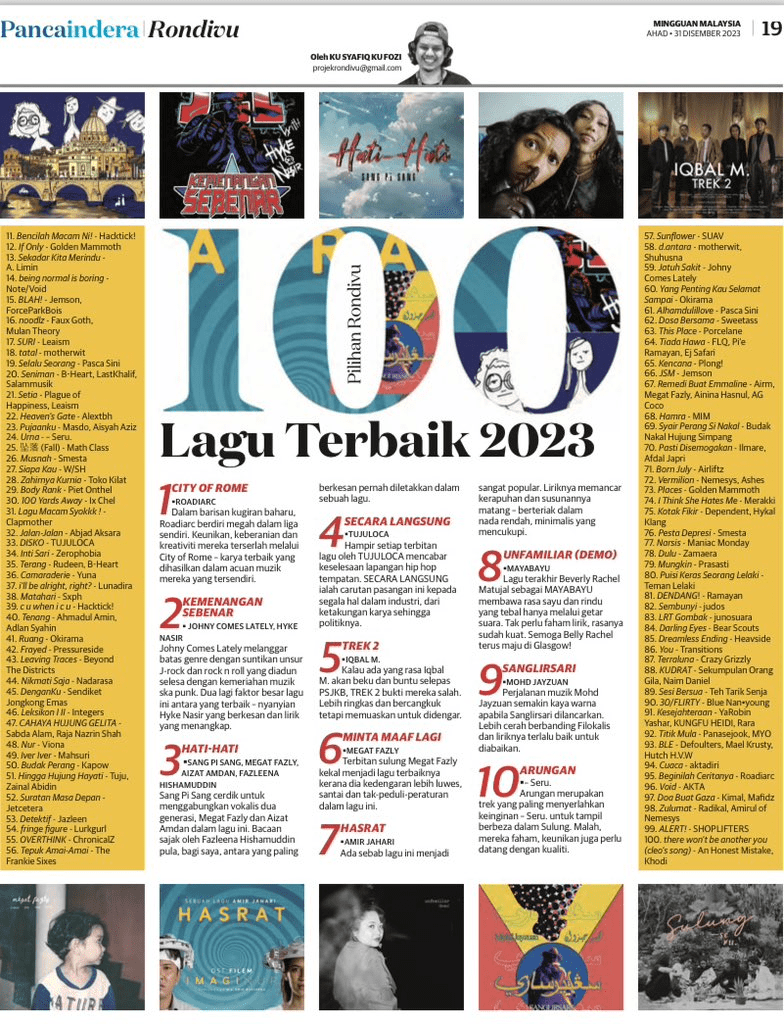
Unfortunately, for many of us, being creatively satisfied is not enough to sustain a project we love. More often than not, they come at the expense of business concerns — making money, paying people, growing engagement, competing with big corporations, applying for funds (Gig Madani, who?). For Ku Syafiq — the only person lucky enough among us to write about music as a full-time job — it was tricky to sustain its momentum, even with a platform as massive as Utusan. A paywall was erected over Rondivu’s articles sometime in February this year, making it more difficult to reach its target audience. Rondivu didn’t generate much engagement, to begin with; Syafiq has mentioned this numerous times. Utusan readers still prefer clickbaity gossip about the outcome of Aliff Aziz’s divorce court hearing to a 600-word critique on the state of independent music. Can you blame them? In fact, anyone ambitious enough to change this mindset would know their pseudo heroic journey would amount to nothing.
So, what’s going to happen next? Print is dead, very few of us want to chip in for a subscription to keep the media afloat, nor do people care about reading free websites. The only mainstream music journalist who’s also an overzealous observer of the indie music scene, extending coverage beyond Hujan and Masdo, is so burnt out that he had to quit just to be able to breathe normally again. The future is blatantly uncertain, as it has long been.
Earlier this year, Junklist announced its closure. Like Rondivu, Junklist played a massive role in shaping my understanding of the indie scene. Junklist was more critical and straightforward than anything else we had in recent years and, most importantly, came from a group of people who truly gave a shit. The first thing I did in response to the bad news was to archive Junklist articles because I couldn’t bear to lose such an important resource of Malaysian modern music.
Syafiq once asked me — perhaps hinting at my reaction to Rondivu’s closure — why I didn’t seem sad when Junklist shut down. I was sad, but in the current landscape of digital media, the closure of pre-pandemic media was inevitable. The website era seems ready to become a bygone era, to be hung in a gloomy museum. Everyone is either pivoting to 30-second summary videos to catch the algorithm’s attention or podcasts filled with obnoxious laughter, unprepared hosts, controversial influencers as guests and the same old topics you might discuss at Mamak restaurants, just add on the expensive microphones and overvalued opinions. When everyone is chasing that 15-minute sniffing high of engagements, you create a media landscape filled with opinions that don’t stand the test of time. We’re witnessing an environment frothing with ephemeral resources that doesn’t possess long-term value. These fast-food resources will eventually become inaccessible for future use and fade into obscurity. They already are.
As surprised as I am by another monumental loss in local music journalism, I’m not sure I enjoy seeing people attending its premature funerals while the rest of us remain locked in the same old dusty room, mourning the losses and feeling nostalgic about the greats. We can celebrate what we’ve achieved while still anticipating the emergence of The Next Important Voices in the Malaysian music scene. That’s exactly what Syafiq did with Rondivu. He succeeded in ways that felt unachievable to local music writers: he archived his Rondivu writings into a book titled Gonzo Tanpa Fiasco and Rondivu was awarded at the Malaysian Journalism Awards 2023, a first for music writing. Rondivu lasted slightly longer than Joe Kidd’s Blasting Concept, even thrived in an era where comprehending criticism feels like an extreme sport, where masses no longer need music journalists to dictate their taste in music. He left a mark on the Malaysian indie music scene – if you don’t feel it now, you will in a few years to come. In celebration of his work, I’m betting that The Next Important Voices are looming. We’ll be fine. We’ll see it again.
Farhira Farudin is a Kuala Lumpur-based writer, whose work has appeared in Malaysiakini, MalaysiaNow, Eksentrika and others. She is the founder of Noisy Headspace.




 noisy headspace
Leave a comment