

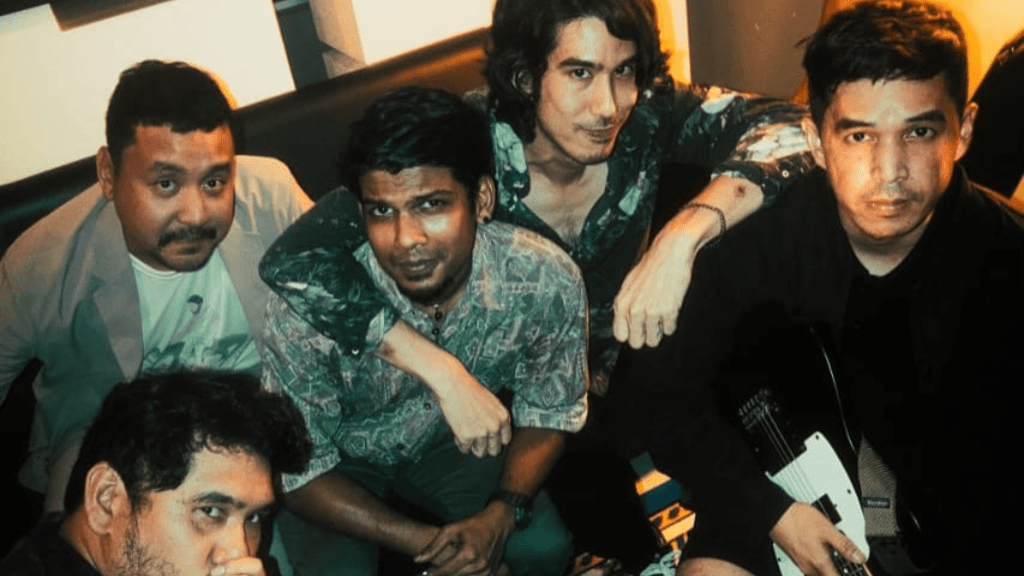
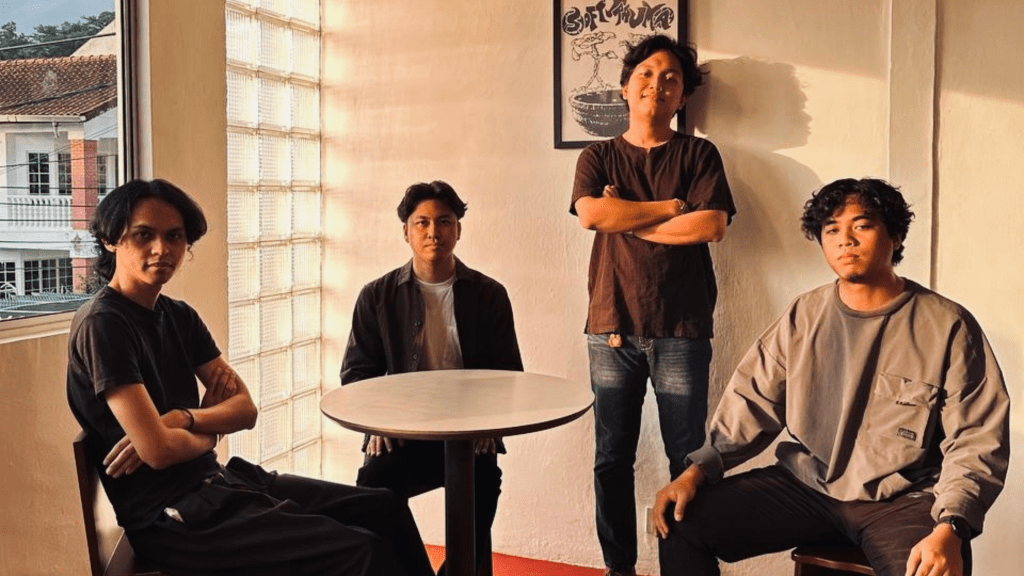
As the shoegaze band Soft from Ipoh casts a spell over the room with their haunting riffs, Zikry, Faidil and Maro of Heavëner stand transfixed in the middle of the crowd. Bathed in the eerie glow of blue and red spotlights, their faces are a mix of awe and disbelief — like teenage boys seeing Superman leap from a bedroom poster into the sky. Their bassist, Zahir, isn’t as fanatic about Soft as the others, so he lingers at the merch booth, fielding questions from passersby about Heavëner’s official T-shirts and CDs. First stunned, then swayed by the music, the trio nod their heads in unison to the tunes of “Eternal Kiss and First Flowers.” Maro, the guitarist and vocalist, pulls out a digital camera to record the moment with his friends.
I hate to break this intimately beautiful scene — friends watching their dispirited heroes with drowned-out riffs straight from cult horror films — but I know I have to. I tap Faidil on the shoulder. “First time seeing Soft?”
He nods, a broad smile of pride lighting up his face before he quickly turns back to his friends. Sure, it’s one thing to finally check off the bucket list and see the cult band that shaped your music live for the first time (“I started playing shoegaze because of Soft,” Faidil tells me). But there is a greater pride in knowing Soft is one of the opening acts for their As Suns And Love Retreat EP launch party.
Beyond performing as an opening act, this marks Soft’s first show in the Klang Valley in five years. In our brief conversation, Soft’s guitarist Amad shares that Heavëner had invited them to play at the right time. “We were all available on the day, so I thought, why not give it a go?”
The release party, aptly titled “As Suns, Fosforus and Love Retreat,” is a collaboration with another shoegaze band and their friends, Dasawarsa, who released the airy, taunting Fosforus EP in January. Located at Drum Asia in Sri Hartamas, the launch party is supported by the emo band Playburst, Klang screamo group Amu Daria, and of course, Soft.
Earlier, Heavëner had a jamming session at their go-to studio in Kota Damansara, a place they frequented so often they no longer needed a key to get in. This ultimate hangout and recording spot has become synonymous with their identity as a Klang Valley band, even though three of them are based elsewhere. Faidil, the drummer and founder of Into The Fray Records, is based in Batu Pahat. Their guitarist, Zikry, is studying in Melaka, while Zahir is in Kuantan. Maro, meanwhile, is based in Cheras.
“Last April, we were working remotely,” Faidil says. “I sent a demo since we were all in different places, but we still wanted to keep the band going. By our first jam session, we had at least two original songs ready.”

Heavëner is also everyone’s first band except for Faidil, whose cavernous, breakneck drumming is showcased in his other projects, including the short-lived shoegaze band Hazing Lines, the Batu Pahat hardcore band Check Your Head and the recently debuted hardcore band Excessions, all heavily influenced by the sounds of ‘90s U.S. hardcore bands like True Form. This year, Maro joins Excessions as its bassist.
The band emerges with their debut EP amid the shoegaze revival already at its peak everywhere else. With TikTok’s obsession with bands like Duster and featuring them on the Spotify wall as the soundtracks of moody train rides, it’s only natural to expect a shoegaze scene to surface in Malaysia. By the time they release As Suns and Love Retreat this year — which they work on before Zahir joins the band much later during their second show — Heavëner seems to grasp what makes shoegaze captivating, fueling its rise here.
The EP’s title, drawn from a poem in the video game Warframe, hints at the personal depth found within its tracks. This time, the drums hit harder, and the atmospheric, twinkling guitars evoke familiar memories, signaling Heavëner’s growing confidence since their debut. “Under The Sun” wastes no time opening the EP with heartbreak: “Take me out under your sun / Under your sun / Tearing the dark and silence.” Zikry writes the song to remember the time he takes a two-year break from university, a period he devotes to caring for his ill grandmother. “The song is for her,” he reveals.
Heavëner’s lyrics reflect a brighter, more hopeful perspective, evident in tracks like “Attain” and “Semoga Yang Pergi Dirahmati, Abadi,” though their sound still leans towards typical shoegaze tropes — dark, almost muted vocals, at times helplessly hopeless. “Attain” also features “Waktu,” a poem by T. Alias Taib, recited by Iff of the noise-folk duo Solaris, while “Sol” includes a duet with Kyra of Pleasantrees. Her performance reminisces of Hope Sandoval’s introverted, hair-tucking persona: “And I tangled in conception / For never be alone / You’ll always be the colour / And I, just black and white.”
As Suns And Love Retreat establishes Heavëner as one of the poster children of the shoegaze revival in Malaysia. In case you missed it, yes, Zoomers are fanatics about shoegaze. A genre once seemingly ruled by the sullen, uncool kids in the ‘90s now decorates the cool kids’ listening monolith and FYP pages. They are all-consumed by bands looking as dejected as possible on stage, cranking up the volume so high that the guitars seem to disappear into the noise. Eye contact is avoided at all costs, the vocals murmur softly in layers, making the language almost impossible to comprehend. Awakened from a long slumber, the shoegaze revival in the post-pandemic world is one of those musical trends no one understands why it happens, but it does. Today, bands like Slowdive are no longer underground, just another band once outcast, kicked off by record labels, now actively touring across the globe, releasing acclaimed material and spurring hundreds more moody kids playing moodier music that you might need a lifeboat to save you from drowning in their overbearing melancholy.
Here, Zoomer-led shoegaze bands are steadily multiplying. It’s evident in the recent emergence of bands like Dasawarsa, Aktadiri, the world ends with you., Dreamscape, Feral, Dogtooth and Chrysanthemum — many of whom weren’t even born when My Bloody Valentine releases Loveless. They’re actively performing and releasing new material this year. Spoors of shoegaze can even be found in other bands’ work, such as Islands’ Changes album and Pleasantrees’ Thought I’d Let You Know EP. So if you need more convincing, yes, absolutely, the shoegaze revival is very much happening around us.
When Heavëner and I arrive in Sri Hartamas, there are a lot of uhhhs and umms as we search for a place to sit and do the interview. A kedai mamak would be perfect, but there isn’t one nearby. After a few minutes of back-and-forth, I point to a cafe just below the Drum Asia venue. It’s a cafe library, with walls lined with bookshelves filled with thick, hardbound law books, their pages mostly yellowed with age. Interpretation of Statutes. Land Law Procedures. All the blah blah blahs that only law students might get excited about. The band seems shy to enter the cafe. “Kami ni orang kampung je,” Fai jokes, hesitating at the door. The rest laugh.
Kampung. That’s a word I plan to ask about later, but for now, I insist we do the interview at the cafe. As I scan my card to pay for an overly frothy matcha latte, I glance outside the glass door and see the band still standing, as if waiting for permission — mine? The barista’s? Who knows? — to sit down.
So, why call themselves “shoegaze kampung”? It’s a long-running joke circulating among the band and their friends, often seen in their Twitter banter and promotional materials. At its most basic, the word “kampung” is Heavëner’s translation of the Do-It-Yourself attitude, echoing the bibles of punk kids who grow up with their older peers percolating DIY culture godfather Ian MacKaye’s manifesto into every fiber of their lives. “Some bands like to perfect their projects before releasing them,” Maro reflects. “But for us, being a shoegaze kampung band just means we use whatever resources we have to get the project done.”
This year, Heavëner kicks off their tour in February to support the German punk band Flirt, traveling from Penang to Johor. They deliberately skip Kuala Lumpur — a decision they frame as a subtle protest against the KL-centric focus of the independent music scene. As the seasoned musician of the band, Faidil channels his experience from Check Your Head into Heavëner’s operations. He implements strict money management rules to sustain the tour, relying solely on funds from merch sales and physical releases, with a firm rule against using personal money.
“We stay at friends’ houses and sleeping on the floor is fine as long as we get some rest,” Faidil adds.
During the last leg of their tour, Heavëner plays outside the country for the first time, in Singapore. It’s an exhausting experience, Faidil recalls, with much of their commute involving a lot of walking. Like, a lot of walking.
“Right after we get off the bus with our cymbals, we have to walk a lot in Singapore,” Maro remembers. The band is depleted after performing, the thrill of a full-house gig and successfully sold merch and physical releases starting to erode. After a night filled with heavy performances and meeting their idols, such as Singapore’s Subsonic Eye, it’s time to go home. “We don’t have money to stay in Singapore, so we have to return to Malaysia no matter what.”
At four in the morning, they board the nearest Causeway Link bus, which, thankfully, is empty. Upon their return to Malaysia, they crash at Dreamscape’s guitarist’s place in Johor Bahru, all completely wiped out. “The tour is mentally exhausting, but we support each other,” Faidil reflects. “Playing in Singapore makes it all worth it. We are so happy.”
At the release party, right when Heavëner takes the stage, the room fractures into distinct pockets of energy. One person behind me translates every joke from Dasawarsa’s set from Malay to English for a friend, while another shouts “Free Palestine!” at the sight of Zahir wearing a keffiyeh. They drape a Palestinian flag in the background. The air is thick with the scent of bubblegum, and the smoke puffs blur the blue and red lights. The crowd is unapologetically familiar with Heavëner; during interludes, one person begins imitating wild birds, another follows with louder coos and soon, a chorus of friends and strangers joins in. On stage, Heavëner quietly tunes their guitars, steeling themselves and, in true shoegaze fashion, avoiding eye contact with the audience.

As they reach the album’s closing track, “Semoga Yang Pergi Dirahmati, Abadi,” the performance swells with theatrical intensity. The song, written during a period marked by personal loss and the escalating genocide against Palestinians, naturally becomes a channel for the band’s grief, making it almost impossible for them not to cry when performing. “It’s introspective,” Maro explains, “a moment for us to express our sorrow.” The track serves as the perfect closure to the EP — a culmination of a harrowing journey where hope struggles to be a genuine companion rather than a distant fantasy.
Just before the song ends, as the fuzzy guitars slow, a shockwave ripples through the room at the climax: Faidil unleashes a guttural scream before abruptly cutting off, while the band erupts into a dwindling finale. The crowd and band shout “Semoga Yang Pergi Dirahmati, Abadi” in unison. It’s the grand finish: Maro collapses on the floor, gripping the pedal board; Faidil gasps for breath; Zikry sinks to his knees, and Zahir stands motionless, still facing the wall. The room falls eerily silent for a few seconds until applause begins to erupt, mingling with the fading echoes of the guitars. The performance is steeped in profound loss, with the band capturing the essence of grief’s acceptance stage; even when surrounded by hope, you never truly let go.


 noisy headspace
Leave a comment