
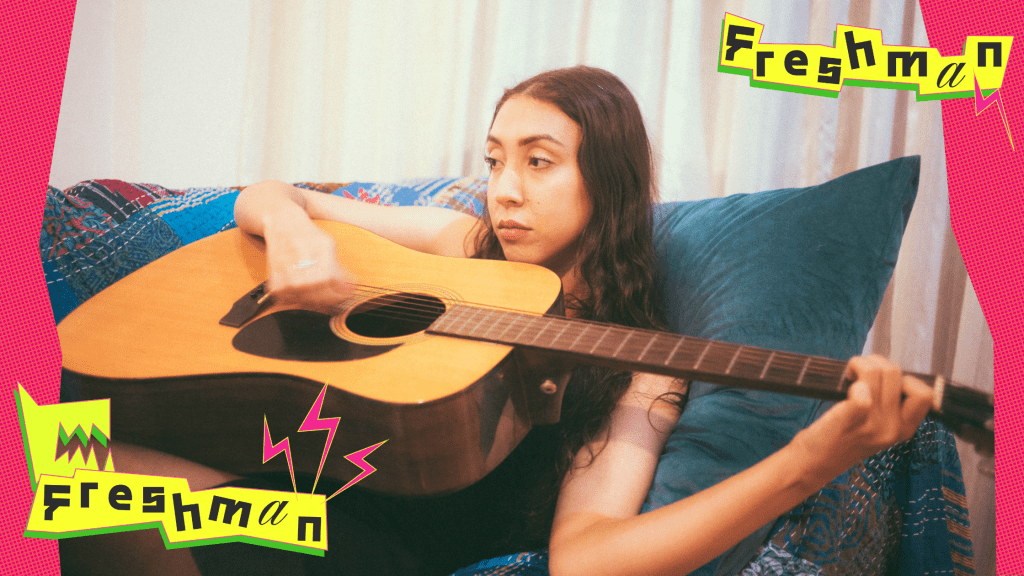
Freshman is a Q&A interview series spotlighting rising talents in the scene. The second Freshman interview features Billie Blue Blackstone, a singer songwriter that just dropped her debut single, “Persimmon Tree”.
Over the phone in April, Billie Blue Blackstone told me about her Japan tour next month. We’ve never met, but the way she talks about it is light and playful, and despite the exhausting logistics, she makes it easy to picture her beaming. The singer-songwriter first made her mark fronting Billie Blue and The Nowhere Men. They played small gigs, landed coverage on Rolling Stone India, released a debut album and stuck together. That is until the pandemic hit. Their guitarist left, and Billie found herself alone at home, drawn instinctively to guitars and poetry.
This year, she re-emerged under her full name, Billie Blue Blackstone. She told me that a random solo trip to Osaka last year led her to a venue owner and, eventually, a chance to tour across Osaka, Kyoto and Kobe. Recently, she released her debut solo single, “Persimmon Tree” — a tender, glowing track shaped by memories of her quiet, lonely, magical childhood in Japan.
We spoke for almost an hour about the single, her magical childhood in Japan and growing out of the teenage insecurities that once held her back. This interview has been edited for clarity.
Farhira: Let’s start with your old band Billie Blue and The Nowhere Men. The band has been around for like a decade, right?
Billie: I think officially we started in 2016. I know that year we played at this indie festival and that’s when we debuted our old originals and stuff. We were playing together quite frequently but things kind of changed in 2020. There was, of course, the lockdown and one of our core members left the band. So that kind of kickstarted rethinking how we’re going to approach it in the future. But we still carried on as Billie Blue and The Nowhere Men.
Farhira: When did you decide to go solo?
Billie: It was around the same period that the thoughts started happening where I started thinking about how it is going to look in the future because I used to write all the music together with that bandmate. He was the lead guitarist at the time, and our music was also very guitar-heavy. So during the pandemic, I started to write poetry and I started to kind of play guitar. So me playing guitar and then writing poetry more kind of led to the songs that I’m now releasing under my name. Yeah. It was that period of exploration that kind of led to this era.
Farhira: You mentioned your band used to be more guitar-driven. Sound-wise, how would you describe the direction you’re taking with your solo work?
Billie: Well, the thing is, like, so I always knew it’s definitely going to be different. Like it’s more me, but at the same time, it’s not as if Billie Blue and The Nowhere Men weren’t me. It was just like a piece of me and a piece of every other member. But now it’s a bit more centered on my range of musical interests. I think this is going to sound a little cliché to say, but my solo work is more feminine, at least my, whatever my brand of femininity is. And I also evolved as a songwriter because in the past, I was just writing lyrics and melodies, but now I am directing like, okay, this is kind of how I want it to sound and stuff. And that’s quite an exciting and liberating place to be because I remember being younger and not really having the confidence to take on a bigger role in songwriting. I feel uncomfortable putting it in those terms because I’m not used to describing the music that way. I’m always used to describing it as like, it’s an “us” thing.
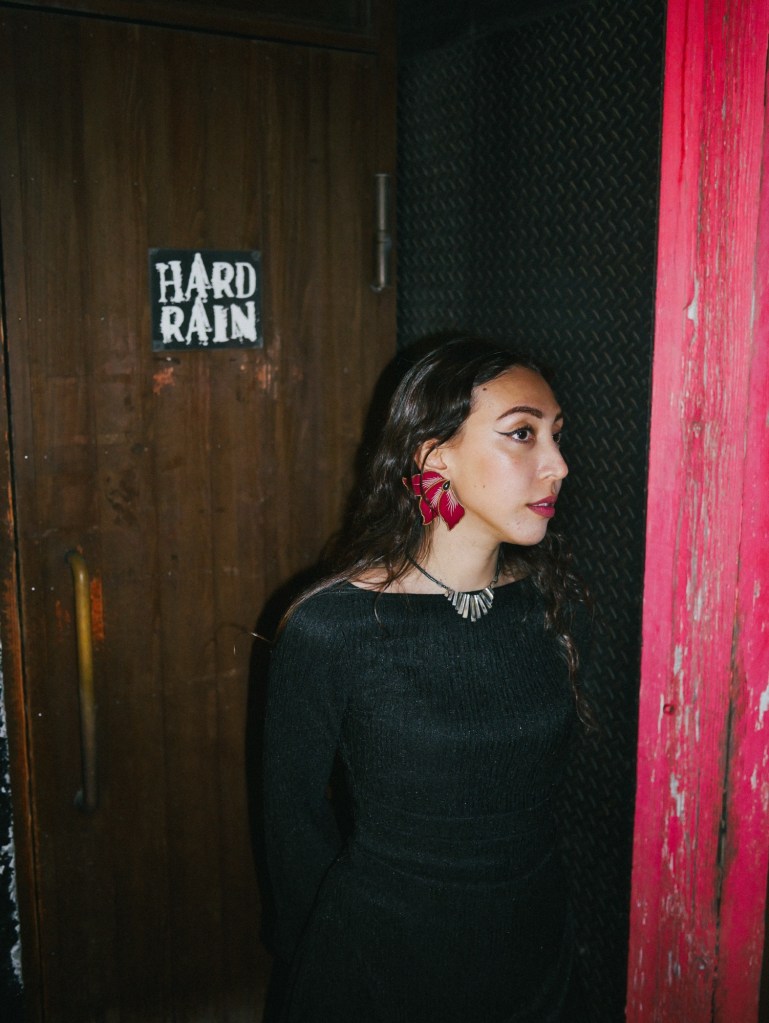
Farhira: When you mentioned influences, right, I was thinking if you could have a moodboard for your new sound for your music as Billie Blue Blackstone, what would you have on the moodboard?
Billie: That’s a great question, but actually I do make moodboards for each song. Okay. Yeah, for “Persimmon Tree” I had like Anita Lane, Laura Marling, a little bit of Fleetwood Mac as well… What else did I have? I also had some Joni Mitchell, some David Bowie on the moodboard.
Farhira: Do you have one for your upcoming EP or album?
Billie: Well, I’m not really focusing on an EP, but I have a couple songs that I’m working on now. I have another one that I’m hoping to have enough money to record and hopefully release at the end of this year.
Farhira: Your upcoming single “Persimmon Tree” draws from your childhood in Japan. Do you mind telling me which part of Japan you grew up in and how would you describe your childhood?
Billie: I grew up in Akita, which is in the north of Japan. So I grew up in a village and everyone knew each other. I would say it was quite a magical childhood simply because I was surrounded by nature all the time. “Persimmon Tree” was named after an actual tree that grew in my garden, and it kind of grew out of the ground at a very slanted angle, so it was really easy to climb. So being a countryside kid, I was always playing outside and that ended up becoming my favourite tree because I could go pretty high up and I would jump down and all. And although I had a lot of friends to play with, I also spent a lot of time alone because I’m an only child. So the persimmon tree has kind of become this symbol of that era and that childhood magic.
I think as I grew up, I lost a bit of that wonder because a lot of fear started to creep in as a teenager. Yeah, a lot of fear, a lot of weird self-consciousness and a lot of not really being able to just enjoy the present anymore because you’re suddenly dealing with all these thoughts in your head that kind of take over. So I think especially during the pandemic, it was such a tumultuous period of time, personally. Like, I had some health issues. I had a breakup. I kind of lost my job, so it was a really difficult time. And I found myself really yearning for my childhood.
And I also kind of realized that I’d been so far away from Japan for so many years. My childhood seemed so alien to me because last year I went to Osaka for one week, but that was my first time stepping foot in Japan since I left when I was 12. And until now I haven’t been back to my hometown. I feel like I kept going back to just being a kid and missing that era and also feeling like it was a dream. Because suddenly, you know, when you move around a lot, you leave behind spaces and you never see them again. People, places that were once part of your routine and part of the fabric of your life, you just give it up and it’s gone forever. That’s kind of how “Persimmon Tree” came about.
Farhira: Yeah, I love how you describe your childhood and how you miss it so much, because I think when I had an early listen of “Persimmon Tree”, the feeling that I get when I listen to it is this quiet tenderness. And then when you give me the context, I think it really reflects.
Billie: Oh, thank you. Yeah. I’m glad to hear that.
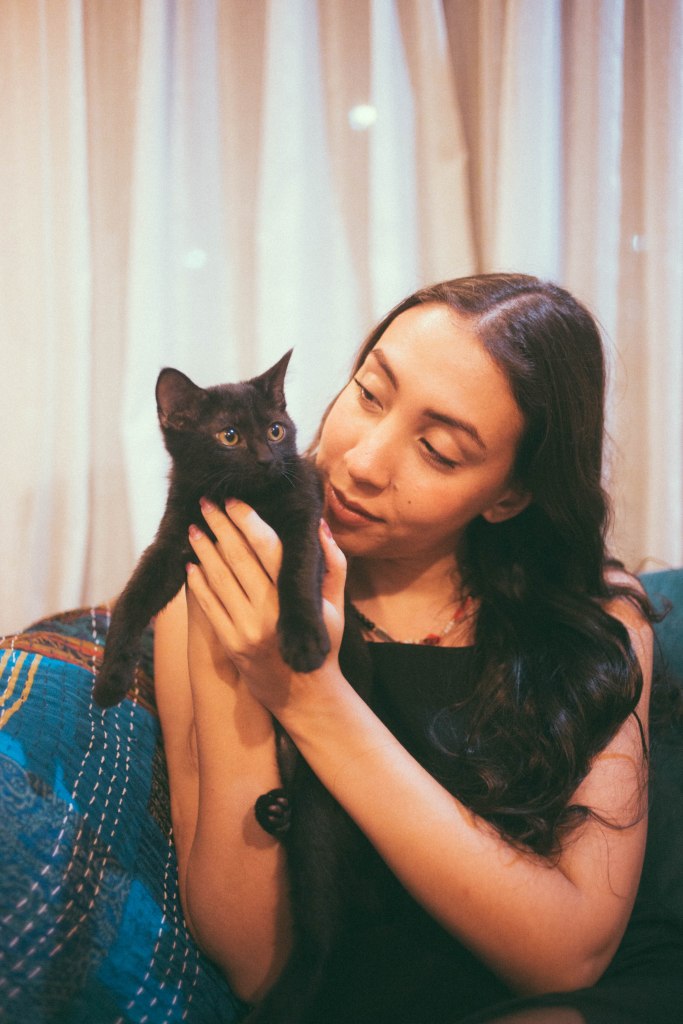
Farhira: Is there any reason why you chose this as your first single?
Billie: I guess this is kind of the first song where I felt like, “Oh, this is my sound.” Not necessarily that all the rest of the songs are going to sound like this, but this was the first one where I wrote all the chords and the melody and the lyrics. Honestly, as a songwriter, it’s been such a journey. I only started writing songs in my early 20s. And I dealt with a lot of perfectionism and insecurity, like silencing myself and doubting my abilities. Even when I first started singing, I didn’t even think I could sing. I was very insecure as a teenager.
It’s something that happens to a lot of kids who grew up in countries that are not where their parents are from because you always kind of feel like you don’t really belong or you’re always hyper-aware that you’re different. “Persimmon Tree” was the song where I felt like, “Okay, I can actually do this.” At the time, I had grown a bit jaded with the older originals I had written, it was almost like I was leaving behind an era and I was hungry to grow out of it. It’s not that those songs were bad or anything, it’s just that they came from a different time in my life. I was a different person when I wrote a lot of the songs with Billie and the Nowhere Men. And when I wrote “Persimmon Tree”, I was like, “Oh, this feels like me now.”
Farhira: So as you grow older, you realised that you’ve become more sensitive to what you want.
Billie: I think there’s that, and I think there’s also the fact that the fear becomes quieter. And the sense of, “I’m going to allow myself to have this experience, I’m going to allow myself to do this,” becomes louder and more powerful. When I said I was reconnecting with my childhood self, a big part of that was feeling like I wanted to unearth the core of who I am. I started to recognize that there were certain parts of my personality that I had been shrouding. Sometimes when you’re feeling depressed, you tend to do that. And I realized I had been doing that just because things were difficult at the time. So I felt this urge to revive the parts of me that I like the most. And those were the parts that were most present when I was a kid.
Farhira: Do you think that all the fear and insecurity you mentioned earlier stem from being a third culture kid?
Billie: I think that was a big part of it. I mean, I’m in a much more secure place now. I don’t think you ever fully leave it behind, but you learn to compartmentalize it. You kind of put it away and go, “Okay, I recognize this feeling. I know where it comes from.” So it doesn’t feel so big anymore. That sort of clarity just comes with growing up, I think. I’m 29 now, so I’ve had a bit more time to reflect and really understand where my fears and insecurities were coming from. And it’s not totally because I’m a third culture kid, it’s not a hundred percent just that, but a lot of those feelings definitely stemmed from it. So yeah. What to do, right?

Farhira: I really like how you shared that you’ve learned how to manage these negative feelings, like, you know how to shut them down now. But are you surprised by how far you’ve come? Like, when we were teenagers, those feelings felt so heavy, so endless. I definitely felt the same. And now, I sometimes catch myself thinking, “Wow, I didn’t know I’d reach this point of maturity.”
Billie: I feel that a lot. I remember when I was a teen, there was one performance where I did sing solo. I remember my voice was shaking, my hand was shaking, like the mic was literally trembling like there was an earthquake. And I only sang one verse, just to open the show. It wasn’t even a song I chose, the teachers picked it, and I remember feeling so shy, so terrified. I think at my core, I’ve always loved performing. I wouldn’t say I love being in the spotlight for the sake of it, but I do enjoy playing with outfits, being on stage, being expressive. That’s my natural self.
Farhira: I read that you faced challenges due to your mixed parentage, especially around your citizenship when you moved back to Malaysia. Do you mind telling me what kind of uncertainties that brought?
Billie: So my parents got divorced, and I moved to Malaysia with my mom. It was a difficult time because I had to be here on a tourist visa. I knew I wanted to be here, in Malaysia, but it felt like there was no clear path to actually stay. We were constantly trying to secure a long-term visa so I could remain with my mom. I mean, this is where her family is. We knew we wanted to be together. But it took seven years.
Farhira: That’s such a long fight.
Billie: During that period, there was just so much uncertainty. When you’re entering the country on tourist visas all the time, eventually you start getting held back at immigration for questioning. I know that my situation is not nearly as difficult as what a lot of others face, there are so many kids who are stateless, or whose parents might be refugees, or where nationality laws are even stricter depending on which foreign country the parent comes from. I mean, even with a US passport, which isn’t exactly a hard one to travel on, I felt incredibly stuck. I had no reason to go back to the US, no real ties there and no solid ties to any other country either. It was a very unstable, insecure period of my life. And that uncertainty just lingered for so long.
Farhira: Do you see this struggle, this long search for belonging, coming through in your music?
Billie: Yeah, probably. There’s a little bit of it in “Persimmon Tree”. And I have another song I’m working on that touches on it too. My songs are usually built around one main theme, but they’re often influenced by a lot of different things, things that have happened or shaped me in some way. With “Persimmon Tree”, that feeling of longing, of looking back and trying to find a sense of place, that’s definitely there. I think when everything around you is so unstable and uncertain, that’s exactly when the need for belonging feels the strongest. That’s when you start searching for it, when you start needing something to validate your identity, your sense of self, your safety. So yeah, I do think it’s something that’ll keep showing up in my music.
Listen to “Persimmon Tree” on streaming platforms today.

 noisy headspace
Leave a comment