

“You in the healing chair! You at the market! Come to the front now!” screamed Isaac Chiew into the mic. It was exactly 5:00 PM, and the Singaporean garage rock band Cactus Cactus had just finished their soundcheck. Their set was about to begin in seconds, yet only a few people moved to the stage to watch them perform. The frontman stood as an electrifying figure with a sly sense of humour — some may call it daring? — calling out twenty-somethings who were too glued to their Decathlon Quechua canvas chairs or taking selfies by the lake to watch the band perform up close. He pointed his finger in three different directions, his voice charged like a teacher demanding attention from sweaty schoolkids at an assembly. Except the floor wasn’t scorching hot cement burning our buttocks in the 9 a.m. sun. This was TAPAUfest 2025 ASEAN, a music festival held in Lenggong, Perak.
After postponing its 2024 edition due to lack of funding, TAPAUfest returned this year with government backing, part of Malaysia’s contribution as ASEAN chairman this year. With that, the festival folded a distinctly Southeast Asian identity into its indie DNA, bringing artists from 10 ASEAN countries across its two-day program. Despite the financial cushioning, one question lingered among skeptical festivalgoers: is Malaysia truly ready for large-scale music festivals like this?
This anxiety is rooted in the controversial history of local festivals, where cancellations aren’t just common, they’re practically expected. For most festivalgoers, buying an early-bird ticket is the equivalent of ordering a set meal with anxiety fried on the side. Malaysians, it seems, are also hard to please, quick to lose trust and perhaps too eager to insist the grass is always greener on the other side. So, is there hefty pressure placed on TAPAUfest? Absolutely.
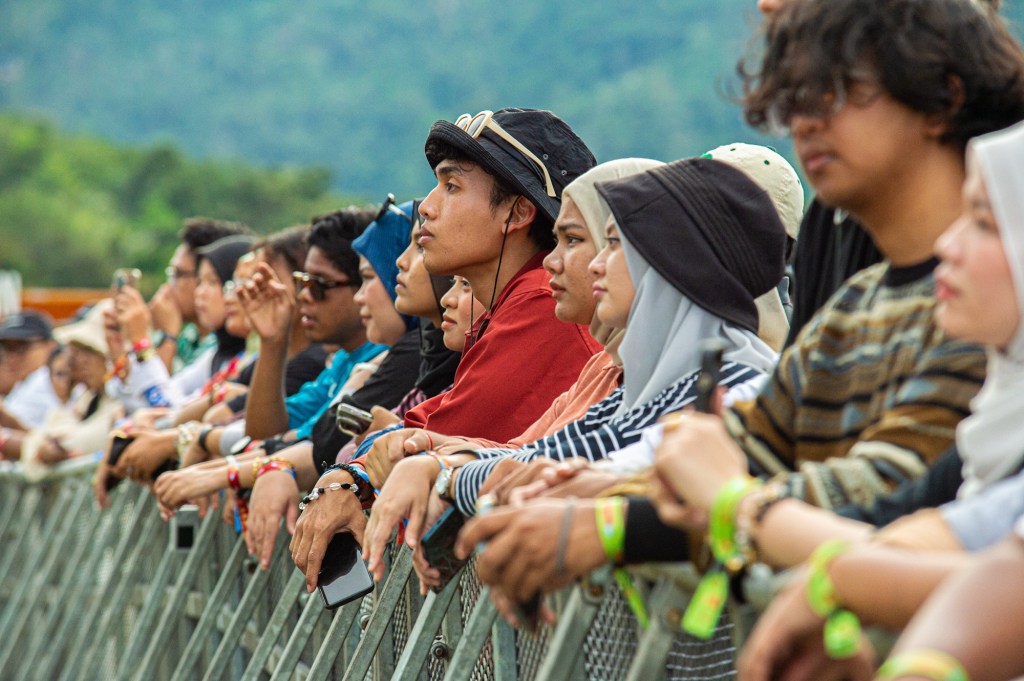
This time, though, TAPAUfest was more prepared than ever. The bare-minimum checklists were ticked and nodded through: more facilities built and prepared for comfort, free outdoor activities for weekend passes holders, PASAR and WARUNG offered Southeast Asian visual arts, merch and food, and BENGKEL and LAYAR hosted award-winning short films by regional directors alongside conversations and creative workshops with ASEAN artists flew from all over the regions.
But the biggest non-music achievement was, surprise surprise, the water station. It became the true star of the show: skeptics festivalgoers who passed by its tent — and the Spritzer’s booth handing out free mineral water bottles — did a double take and realised that common sense from festival organisers could, in fact, exist.
Those who’ve attended bigger, better festivals overseas might taunt the idea that locals struggle to provide even the bare minimum. But after the fiasco of Latihan Pestapora 2025 — the first international event under the Pestapora brand held outside of Indonesia that infamously failed to provide a water station or enough stalls selling mineral water in an 80,000-capacity stadium, forcing people to allegedly pass out, drink straight from the pipe or scavenge for half-empty bottles off the ground — comparisons, and even the opportunity to disparage that festival, became inevitable. At TAPAUfest, achieving such a basic and small necessity earned them an easy gold star, only because other organisers couldn’t even dream big enough to pull off.

On Day One of TAPAUfest 2025 ASEAN, the festival welcomed its crowd to the gravely hot weather and missing internet signals that didn’t help much with my live reporting. Thankfully, when stoner rock band Raksar opened the stage — wearing biker outfits, tight leather pants, and one in a kurung kedah — all the burning heat and no-5G worries were gone. For the smallest band performing at the festival, and carrying the hulking responsibility of representing Perak — a tradition the festival has practiced since 2022 to let a Perak-based band represent the state — Raksar blew the stage away immediately. “Tumpor”, a song heavy with Perakian dialects traced from Bota to Kuala Kangsar, was especially a pure joy to witness. The festival stood by its decision not to provide an LED screen as a backdrop, so while the members of Raksar threw guitar solos into each other’s heads, the strong breeze blew their curly hair, and the trees behind them, accessorised with pink and green cloth, made for one appealing sight. Opening a festival where the main attraction for its target audience is either a popular act from Indonesia or the Insta-worthy view itself is a challenge — but clearly, Raksar rose to it.

This year’s lineup carried parallels between Day One and Day Two acts. Raksar, for instance, had its counterparts Cactus Cactus opening Day Two. Both bands, despite heavier sounds that clashed against the serene backdrops, stood out as some of the best acts at TAPAUfest. If you came to the festival seeking only #healingvibes, you’d miss the rare, bold edge that bands like these bring. It wasn’t easy for Cactus Cactus to lure people to join the fun but this challenge isn’t exactly unique to TAPAUfest. From many local festivals I’ve attended, festivalgoers seem more comfortable showing up only for the acts they already know and love. It suggests a possibility that in this age, the art of music discovery often feels confined to an algorithmic Spotify homepage rather than the thrill of stumbling upon something unexpected at a festival they paid money for. Still, the band’s relentless, mischievous frontman Isaac Chiew made it worthwhile: by mid-set, a small mosh pit had erupted, a guy hoisted a Negeri Sembilan flag while perched on another’s shoulders. By the end, all was well for Cactus Cactus.

Meanwhile, Yogyakarta’s Skandal carried the pop-rock lineage of Indonesian staples like Sheila On 7, their set recalling the approachable melodicism of Perunggu, who also marked their Malaysian debut on Day Two. From Bangkok, KIKI brought electronic-pop sparkle to Day One, complete with a giant beach ball bouncing across the crowd in the dark, while Bandung’s electro-pop duo White Chorus charmed with a genre-blurring set (though it felt too short.) Their cover of Acha Septriasa’s “Berdua Lebih Baik” sent the crowd into a roar, hitting especially hard for those who were still in primary school when the 2006 hit film Heart came out. Local indie-pop trio FUGO, who have had a breakthrough year, played with a newfound confidence, tighter rhythm and the shortest pants they’ve worn on stage — perhaps a gesture to fit in with the natural landscape they’re surrounded in. Their closing number, “Pentas Sandiwara” swelled into something communal as the audience carried its final verse — a scene that hinted at the band’s capacity to follow, if not surpass, the popular ascent of Insomniacks, who appeared the following evening.

The collaboration between the post-rock unit Seru and the Langit Vanilla-famed poet Wani Ardy continued to be a fruitful one too. Wani Ardy’s performance felt both possessive and tranquil at once, further heightened by the strong wind blowing through the entire set. Towards the end, she asked the audience for a word or story to be turned into spontaneous slam poetry, becoming both an exercise in her craft and a chance for the audience to taste something new. A girl screamed “kesunyian” — a common theme in practically every anak senja song — but Wani turned it into a charming improv, though her angle barely scratched the surface of such a heavy subject. Afterward, I heard someone wonder if the set would carry the same magnitude had it been performed in an air-conditioned hall — some place more modern, less gorgeous than what Lenggong offers. But it would be a mistake to think Lenggong was the main character in their set. Because Wani Ardy clearly took it all.
Since the lineups for each day almost mirrored one another, the diversity of genres felt like a missed opportunity to explore. Wider palate such as hip hop could have been represented by collectives like 53 Universe and the Gen-Z-adorned SLATAN, or even Indonesia’s jazz-electronic trio Batavia Collective and soul/jazz unit Thee Marloes — all of whom could have shaken Lenggong a little more, simply by offering the audience a broader taste. Speaking of singular taste: when a festival leans so heavily into nature, music like Okirama’s lo-fi love songs and Sal Priadi’s theatrical antics seem destined to fuse with the majestic mountain ranges of Bintang in the west and Titiwangsa in the east. Okirama, especially, appears tailored to the majority of the audience’s taste: mostly quintessential youngsters who likely discovered the band from their anak indie peers, whose music taste leans toward first-love songs layered with looping synths. And when the Johor-based band was positioned as the sunset performance against Lenggong’s sky, expectations naturally mounted. What we got instead were songs that felt too short, too inelastic, too digital for the emotions to fully settle while the sun slowly drowned itself in the background. Before you could close your eyes and let the music simmer as the Lenggong breeze brushed softly against your cheeks, the songs had already ended. If Okirama’s strength lies in their atmospheric, intimate bedroom pop, then that very strength may also be their biggest limitation to adapt for a stage as expansive and magical as TAPAUfest.

With its headliners, however, TAPAUfest presented two major players that not only stood in contrast to each other, but also made a bold choice in letting Couple close Day 2 and by extension, the entire festival. While Sal Priadi’s charming stage presence amplified his commercially successful hits, complete with giant sunflowers waved by screaming fans, Couple’s nostalgic pull went deeper than a legacy act revisiting old favourites. With a strong discography, a reputation that bridges early indie celebrity status and decades of quiet endurance, the Ipoh power pop band made it effortlessly clear why they deserved the headlining spot. Every song in their set taken from 2006’s Top of the Pop to 2022’s Poptimism reaffirmed the influence they still hold.

Midway through, the band brought on Hana (guitar), Ihsan (drums) and Ojoe (bass) from the original Top of the Pop lineup, marking their first performance together in 19 years. Songs such as “Tentang Kita” and “Come Back Again” elevated the show beyond nostalgia bait, transforming it into a sparkling display of a band still thriving with ease, with a crowd that spanned generations. Even if nostalgia was the ultimate offer here, Couple proved it was worth every bit of our attention.
When the festival closed its main stage and Zainal Abidin’s “Hijau” rang out — the now-traditional cue since 2022 for festivalgoers to help pick up trash — most people drifted off, either back to their tents or straight into the city. What many missed were two unannounced bonus acts at the Santuy Travellers campsite: soulful singer Leaism and singer-songwriter Megat Fazly, who appeared on Saturday and Sunday respectively.

I managed to catch Megat’s set, played before fewer than thirty people, most already in their pyjamas, cosy as if waiting for a bedtime story. Behind me, someone was cooking sausages on a small stove, while a few perched outside their tents and others sat in camping chairs, singing along with Megat to “Berseri” by the bonfire. He was joined by bandmates Aizad Khan on bass and Zaiff Sharqil on violin, weaving through his slow-pop singles from his much-anticipated debut album and a string of covers, including Yuna’s “Penakut” and The Times’ “Gadisku Dalam Koma.” As requests piled in for more covers, the performance stretched on. “This is our last song for the night,” Megat joked at least five more times, but the audience wasn’t ready to let go, dumping more and more requests to coax the trio to stay longer. What began as a one-hour set turned into two, making it a warm and spontaneous extension of the night. Though absent from the official bill, the intimate, fireside performance felt essential to the festival itself — another reminder of why TAPAUfest carries a charm no other local festival can quite match.
This year’s TAPAUfest probably drew about the same crowd size as when it first began in Lenggong. From a drone’s eye, it’s not exactly a sea of people but rather a scatter of small gatherings with friends stretched out on plaid nylon mats, some looking toward the stage, others toward the glimmering lake that sits alongside it. That’s not exactly a sad sight to witness.
Over time, TAPAUfest has stretched into the sort of festival people speak of not entirely because of who played, but because someone they knew went and came back with glorious stories. With this year’s edition being its biggest and perhaps the best, it’s easy to see that next year’s draw won’t rely mostly on the lineup, but on the hype built around it. Sure, hype alone isn’t enough for the organiser to pull in ticket sales but its third edition surely has succeeded at capturing what a festival should be: an experience that makes music feel all-encompassing, not limited to the stage alone. And if hype is all they can offer, you’d better believe in it.
All photos by NRDN Photography

 noisy headspace
Leave a comment