

Illustration by Maira Zamri
You’ve seen it. We’ve all seen it. A new local boyband was announced recently as part of a marketing campaign by a fast-food brand. Project Thric3 members are called Adam, Cedrix and Kaizer, they wear leather jackets, their skin looks oddly smooth and shiny, their smiles a little too forced. The trio is diverse, you can tell from their names and how they look like different people in every scene. Their existence feels soulless and cheap, a gimmick latching onto the latest trend. And that’s exactly what it is.
Project Thrice is the first AI-generated boyband in Malaysia — this country certainly takes pride in being the first at everything, though rarely the best — whose promotion sent a wave of anger through the independent music scene. The announcement post was flooded with furious indie musicians, lamenting how hard it already is to fight for space, only to see such a massive opportunity handed over to artificial intelligence.
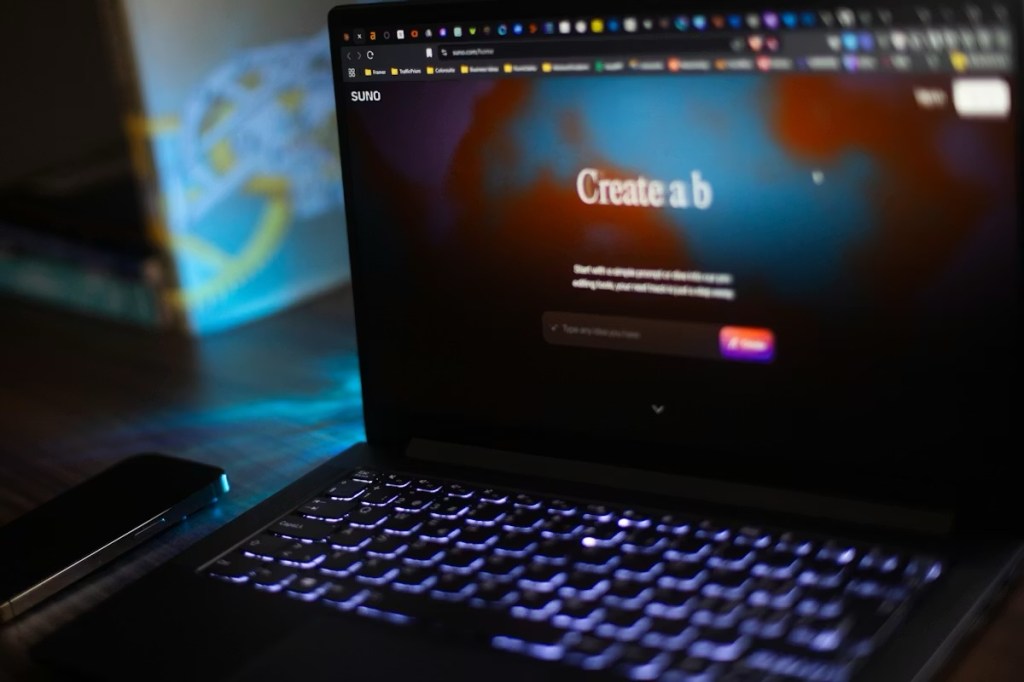
But this isn’t the only AI-generated fiasco in the music industry this year. Earlier, the internet was suddenly flooded with millions of personal images — including of local bands — transformed to look as if they belonged in the Walmart version of Studio Ghibli. A quick visit to Bandcamp’s “Malaysia” tag now reveals more AI-generated music with AI-generated cover and AI-generated caption. You see it, too, in the cover art for many of the Top 90 nominees of Anugerah Lagu Indie 2025; in concert backdrops built on AI-made videos; and in music videos padded with AI visuals.
If you had asked an independent artist five years ago about the idea of using an artificial intelligence to process prompts and spit back results that supposedly expedite creative work — ones that feel less and less human with each iteration — it would have sounded demeaning, even absurd. The practice feels lazy and corporate, as if the term “indie” no longer signals a principle but merely an aesthetic — a thin, dangerous line that many have already crossed even without AI. But that reaction belongs to another time. It’s 2025 now, and even independent artists are opting for speed over the slow, meticulous process of learning and figuring things out — all while competing with algorithms for who can capture the most attention. A.I. is marketed as the ultimate all-in-one tool, a selling point many independent artists, hungry for recognition and validation, are quick to bite into. For those who fully embrace it to skip the work and let machines do the heavy lifting, speed comes first. Accuracy or quality comes much later.
Haryth Hilmy, the bassist of pop punk band d_leted, has an X account that seems almost dedicated to calling out his peers for using AI-generated visuals. In a sea of X users tagging @Grok to summarise internet gossip, Haryth’s efforts stand out — somewhat bold in a scene that’s still largely silent about its entanglement with AI. As an illustrator himself, Haryth feels a responsibility to protect his rights — not just as a musician, but as a visual artist, too. Over the phone, he clarified that his stance isn’t entirely against A.I. In his own music, he uses it to help with technical chores like separating stems.
“The key word here is assist, not create,” he said. To him, A.I. ‘s place in the scene is clear: it can be a tool, as long as we don’t hand it all the hard work. And given the current rate of dependency, he’s not wrong.
Much of the discourse around A.I. both in the music scene and beyond always seems to end in a tangled knot. The end goals we want are often black and white: you’re either fully for it or staunchly against it. But neither position reflects the reality we’re living in, where A.I. usage in the arts has far surpassed generating silly images or writing basic emails. Now, we’re moving at a speed that even its creators are either shocked by or actively warning us against. There’s no rewind button in this world where we no longer need A.I. — it’s already everywhere. It’s in billboard ads, fast food menus, my favourite band’s music video, LinkedIn posts written by clicks-desperados, every app, every search engine. I’ve come to accept that we’ve passed the point of no return. Even the skeptics who once believed A.I. might eventually plateau have realised that the future isn’t coming. While we’re still debating whether generating A.I. images are ethical, the tech bros behind this creative bedlam have already shifted focus to building Artificial General Intelligence, or AGI — a superintelligence designed to be smarter than humans, capable of performing nearly all cognitive tasks we can. When Sam Altman’s wet dream finally comes true — whenever that may be — the debates we’re having about A.I. won’t just end in knots. They’ll snap entirely.
But A.I. can’t take all the blame, can it? The problems it has spotlighted in the scene have existed long before A.I. itself. Lack of infrastructure, limited funding, censorship and conservatism — these have been around for years, sustained and perpetuated by us, the humans. To frame A.I. as the primary enemy would be unfair. Not to A.I., but to the scene itself. Instead of playing the blame game, we should be asking each other a thousand different questions about what AI can and cannot do for the independent scene. To control AI in the independent music scene — or at least to sadly live with it — we need to define a new set of values, ones we’ve never had to do before. We need to put in the extra work to define and protect the role of human artists: to give credit where it’s due, to cultivate and uphold thoughtful criticism and to bring out a more discerning audience.
On that last point, I’m reminded of something Fran Lebowitz said in Public Speaking (2010), a Martin Scorsese-directed documentary about her life and work. She argued that the AIDS epidemic didn’t only rob the world of artists — it also erased an audience. Her first real readers, she explained, came through Interview magazine from the late ’70s, when most of that audience was gay men. “That audience was very important to me; this was part of what formed my voice,” she said.
What struck her, looking back, was how little attention had been paid to that absence: “Everyone talks about the effect that AIDS had on the culture. People don’t talk about it anymore, but when they did, they talked about what artists were lost. But they never talked about this audience that was lost.”
That audience, she stressed, wasn’t just loyal but discerning, with a taste for art that raised the standard for everyone else. “There was such a high level of connoisseurship of everything that people like this were interested in — everything that made the culture better.”
“A very discerning audience, a very high level of connoisseurship, is as important to the culture as artists. It’s exactly as important,” she added.
It’s easy for skeptics to criticise the independent scene’s stagnancy by pointing to the supposed absence of great artists. But if that were true, I’d counter with this: we also lack a great audience. We lack an audience that not only appreciates the aesthetics of art but understands its language. An audience that doesn’t expect every piece of music to be easily digestible, neatly packaged or spoon-fed with meaning. We lack an audience that cultivates its own taste organically and trusts it, instead of relying on corporate-driven algorithms. An audience with high cultural literacy, one that doesn’t treat art as disposable but documents, preserves and builds upon it. One that still sees the importance of criticism. One that isn’t perpetually glued to the greatness of the past, clinging to nostalgia like a newborn to the warmth of its womb. It’s more important now than ever to build a strong taste, to hold onto it and to share it. When we recognise the true value of human work — as artists and as audiences — the presence of A.I. will begin to fade into the background.
The good news is that it’s never too late to build a discerning audience within the scene, even as A.I. catches up with us. Fast. Whether the problem lies in the absence of great artists or great audiences, the bitter pill to swallow is this: A.I.’s presence isn’t propelling us toward some successful version of the present — as pro-A.I. musicians like to claim — nor is it about to “take our jobs” overnight. It’s simply amplifying the problems that were already here. Now, with AI deeply embedded in the scene, it’s clear: the fight is far from over.
 noisy headspace
Leave a comment