
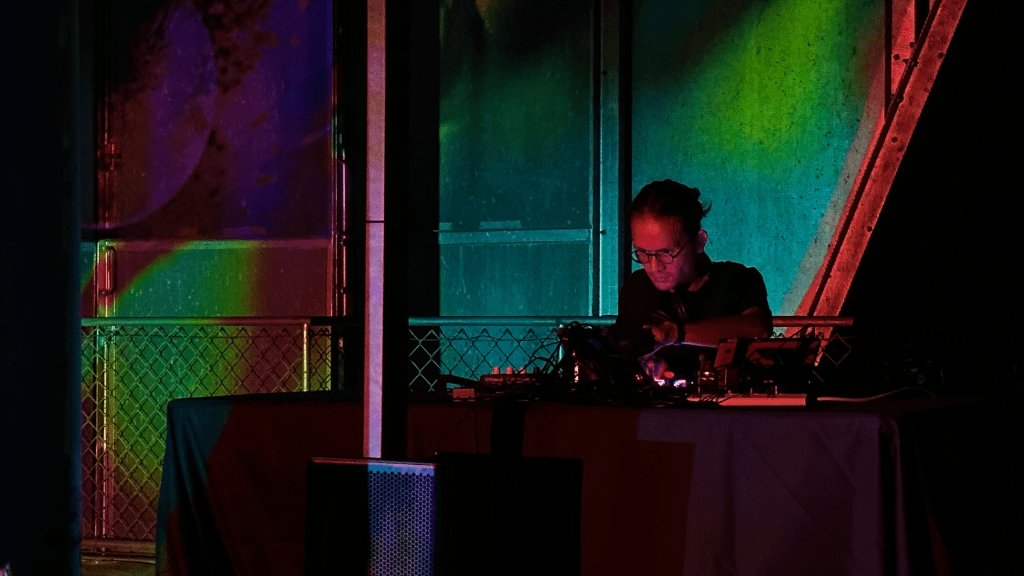
Naqib Idris says he’s still surprised by where life has taken him since he started making music years ago. The former financial journalist turned multidisciplinary audiovisual artist first tapped into music during the pandemic. When lockdowns kept everyone indoors and samplers suddenly became portals, making music to express oneself when the world fell silent felt like the only thing that made sense. The birth of his solo project, Cerikapak, was as random as it gets, yet that randomness cracked open a pathway: crafting his own interactive visuals as the missing puzzle piece, performing across the country and eventually contributing to theatre works as far as China.
Earlier this month, Smol Records released the physical edition of his new album from the hollow place. — complete with a launch party where audiences wore 3D glasses and submerged themselves in its abstract visuals and airborne sonics. Now six years into the project, Naqib says the most freeing thing to do is no longer hiding himself behind the moniker. Over Google Meet, we spoke about the spontaneity inside his perfectionism, the trap of data-dumping music and what it means to loosen himself from his own cocoon. This interview has been edited and condensed for clarity.
Farhira: Hi Naqib, wait, I can call you Naqib, right?
Naqib: Yeah, yeah, Naqib. Some people call me Ceri. (laughs) It’s kind of a funny thing now, because I just made up that name on the spot, and now people just call me by that name.
F: That’s funny, because my first question to you is why is your stage name Cerikapak?
N: Back in 2014-ish, I used to run a skate brand with two other friends. It was called Cherry Bomb Board Co. It lasted for a couple of years and then we shut it down. We used to have a skate session every Wednesday night in the car park at Tropicana, and we called it the Cherry Car Park Sessions. We’d always play music and we had this traffic cone with a Bluetooth speaker inside it, and everyone contributed to this playlist called the Cherry Car Park Playlist.
At the same time, I was exploring music and people would say, “Put up your music.” I didn’t want to use my real name, so when I started a SoundCloud account, I just used the Cerikapak name. That’s the brief story behind it.
F: So what year did you start making music?
N: I think I started posting stuff in 2019, right before COVID. I don’t have any formal music education except I used to be a drummer in high school. I used to be very into bands growing up, but around college time I got really into electronic stuff, dubstep and things like that. Then I discovered the softer side of electronic music, and I was puzzled by how they made those sounds, like, what instruments did they use? That brought me into sampling and synthesizers. I didn’t really plan to start making music. Even now I don’t really know what I’m doing, to be honest.
F: You didn’t have a formal background so the decision to make music seems sudden. What led you to that decision?
N: I started with just one sampler, a tiny one called a Pocket Operator. Back then I was still working full-time as a journalist, and that year we got a bonus. I thought, “Hmm, what should I spend my money on?” I saw this thing in an ad, thought it looked interesting, watched videos on it and since I was already into sample-based, lofi hip-hop stuff, I bought it. That sampler could do those things, but it was very limited. From there, I got the hang of sampling, started to enjoy it and began buying more gear. It just spiraled from there.
F: When you started buying more gear and got deeper into it, did you have a specific goal in mind like, “I want to achieve this” or was it just “I’m just gonna see what happens”?
N: Honestly, it was more consumerism than anything else. (laughs) I’d see someone with a cool device or effect on social media and think, “That’s what I need.” Eventually, I stopped and focused more on the software side. Before that, I didn’t really know about software like Ableton. I thought to make electronic music I had to learn synthesizers from scratch but now I know you can start on a computer. It’s cheaper, too.
But I’ve always been into hardware. I used to order parts from China, wire them myself. I’m very interested in radio signals and things like that. So I was attracted to hardware like, wow, you can create any sound from this particular synthesizer. It’s an interesting concept that you can create any sound if you know how to break it down. I didn’t go into it thinking “I want to make music.” It was more like sound exploration. Later, I learned a bit about arrangement and thought, “Actually, anyone can make music.”
F: When was the first time you performed your music live?
N: My first show with an audience was in 2021 at the Safehouse in TTDI. That was part of a compilation of local electronica artists called Botanika. I was so touched they wanted my music on it.
F: Were you nervous to play in front of an audience for the first time?
N: Yeah, of course, because I have really bad social anxiety. I still do, a bit. I never know what to do when there are some parts of a song that just plays itself. (laughs) But now, I have visuals in my show, so I can distract the audience with that.

F: Was that the intention behind having visuals in your shows?
N: Since TikTok came in, everything has become very video-based. So I thought I needed animation or something, because I didn’t want to be dancing in front of the camera to promote my music, I’m not that kind of person. (laughs) So I thought, hey, why don’t I do some visuals? And that opened a can of worms. I liked doing visual stuff, so I learned the software TouchDesigner, and it opened up a lot of other opportunities even in music and stuff, like designing visuals for other artists.
F: Ever since you include visuals in your performances, do you think your music feels more complete now?
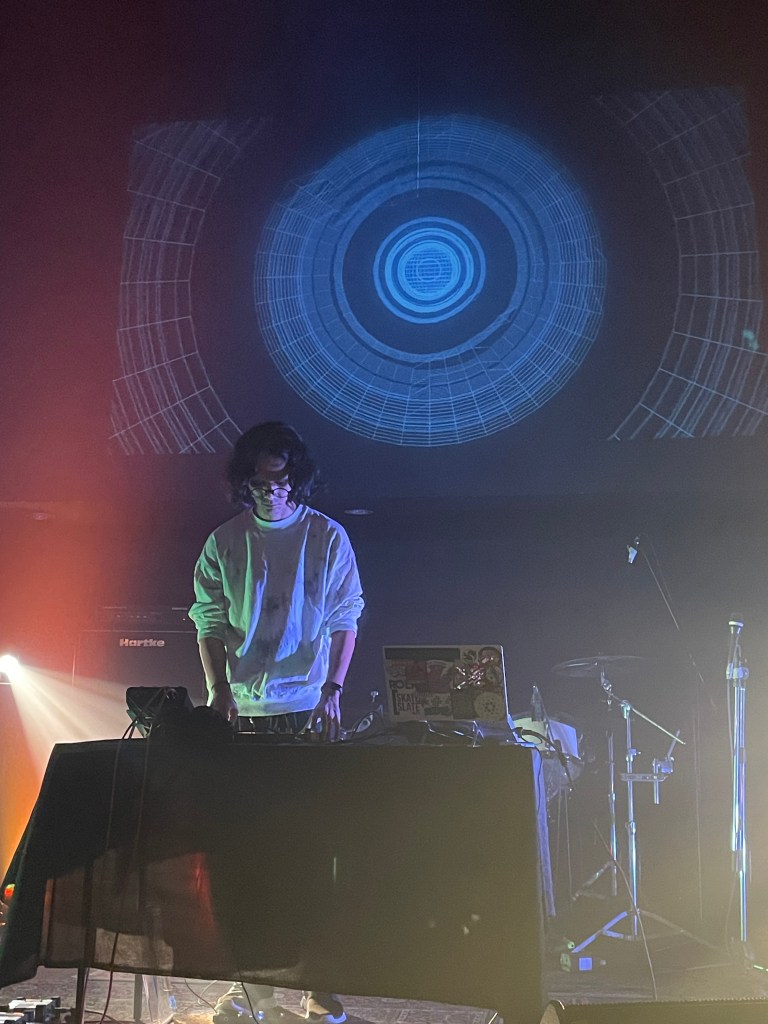
N: At some point when I was performing, I really wanted visuals to accompany my music. Ever since I was a kid, when I listened to music, I’d sometimes see a music video in my head even if it’s just a random song. I didn’t realize how visual I was until I started doing visuals and felt like I had a knack for it. But it’s more programming-type stuff, what they call generative procedural media. And my visuals are interactive. In some shows or theatre production, I have a controller so the audience can play with it. It’s not really a fixed setup; it’s more go-with-the-flow. But it’s more intentional now compared to just doing whatever.
F: So when you produce your music, do you visualize how it would sound?
N: Not really. I sample a lot of stuff. When I’m walking or on a train, I’ll record sounds and put them in my sampler, then just start jamming. If something sticks, I go with it. Most of the time I start with drums because I used to drum a lot. So if you notice, my music’s drums can be a bit hectic, but the chords are pretty simple. I’ll just keep layering stuff until I find what works and go from there. I don’t go in thinking, “I want to make a fast song.” It’s sort of an expression at the moment. Ceh, so pretentious. (laughs)
F: Since it’s very much an in-the-moment process, how long does it take you to finish a track?
N: For the recent album, some songs were sitting for one or two years. I wrote them a while ago but didn’t finish or feel them at the time. For this album, it was mostly Adam from smol records who pushed me to release it. So I was like, okay, there’s a deadline, I should just finish the music.
F: I was about to point out some songs off from the hollow place. were already released back in 2024. And now they’re part of the album. How did you decide to finally release it as an album?
N: Back in 2024, I joined an Ableton course. Before this everything was cincai and I only learned from YouTube. Some things I couldn’t grasp until that course. One of my friends said, “Hey bro, your arrangement is nice, but your mixing is really bad. You need to learn to mix.” So I learned a lot because I had someone go through my music and point out where I was going wrong, like why it didn’t sound nice at venues. So for this album, I wanted to test those production skills I learned, which is why I redid some of the older songs but this time, mixed them better. Now I kind of know a bit more about what I’m doing.
F: So when you list down the songs that will be included in the album, did you have a specific theme in mind?
N: I actually wrote an entire other album which I didn’t release because I hate it. It had like 20 songs, but I was going through a very turbulent point in my life at that time. And when I was going through the music, I didn’t feel like releasing it. So the other album was a bit mellow and ambient and a bit sad.
F: So did you scrap the album only because it reminds you of bad memories or did you not like your work in that album?
N: Initially, I liked it. I even played it live a couple of times, but I feel like I took a bit too long to finish the album and then I kind of got sick of it. And the songs also reminded me of that time, which has already passed. And now I’m in the New Year, new me type thing and I’m like, okay, I can’t relate to the old music.

F: There’s a voice announcement in the song “kosmosfera”. Where did you sample that from?
N: It’s actually a UFO report from Sabah airport. So back in 2007, they spotted giant cylindrical beings flying to the airport. And when it reached the airport, it just disappeared. So there’s this news coverage on it, but not many people know about it. I like to dig YouTube for obscure samples and things like this.
F: Interesting. Are you fascinated with this alien stuff?
N: Yes. Are you gonna put that in?
F: Yeah!
N: Okay lah, boleh. I think I want to capture a bit of the spacey vibe. I like the mystical, esoteric, a bit cultish stuff.
F: Another thing I noticed when I was looking through your discography is that your music is often inspired by places such as Tokyo, Delhi, Subang, Damansara. Is there a place you never expected to be inspired by, but you ended up doing?
N: I think Delhi was a big one. And the song “Delhi Midnight” has the main hook of some random guy I saw on the street that was playing his instrument. I have learned this technique where when I’m putting on music, I will just start playing random loops that I have, like that I’ve recorded just to see if something clicks. Then I might insert it.
F: So you improvise a lot.
N: Yeah, it’s improvisation, but it’s also not entirely improvised because I’m recording from another source, right? I’m not directly producing the sounds. Some people will say it’s not real music if you sample, but I don’t really care.
F: You know I’ve been thinking a lot about how accessible it is to make music. Like I’ve spoken to a musician who produced an entire project just using his iPhone before. And for electronic music, I think the boundary feels even more open. Do you see this too?
N: I feel like it’s much easier to get into it now, especially with YouTube. But if you don’t know what you want to do and just keep watching videos, you won’t get anywhere. It becomes this loop of constantly learning new things without a clear direction. And if you just follow YouTube tutorials to make a certain genre or sound like a specific artist, you risk getting locked into that sound. You have to start experimenting more.
F: I think the reason I’m so interested in this is because I always go through Bandcamp to check the latest local releases. I’ve noticed there’s a lot of electronic music coming out even more than other genres. Some artists release multiple albums in a year, and it kind of blurs the line between what’s a finished work and what’s more like just dumping projects online. How do you draw that line for yourself? Like what gets released, and what stays in your drafts?
N: For this album, I had a whole list of songs and ended up picking eight. I chose the ones I liked that seemed to fit a similar theme, even though I didn’t really know what that theme was. I just felt these songs shared a certain vibe. It also depends on how I’m feeling at the time. Sometimes I’ll finish a song completely and then decide I don’t want to release it. Other times, I end up hating it and don’t want to listen to it again. It’s very unpredictable.
F: The reason I brought up the idea of releasing too much music as “data dumping” is because when I look at your discography, it doesn’t feel suffocating. I can see, okay, here’s a single from 2024, a single from 2021, and an album just released this year and it’s easy to follow. Meanwhile, like I said, on Bandcamp, some electronic artists release so much at once that it becomes hard to keep track. I mean, how is anyone supposed to properly enjoy the work when nothing is left out?
N: I think when it comes to electronic music, it’s a bit of a grind culture. You get gigs, you could play the biggest clubs, and one day your songs are played by the biggest DJs. There’s a lot of that hustle mentality like you have to drop a release every month or every other week. But I don’t really do those kinds of things because, honestly, I’m just doing it for myself. I like it as a hobby. Some producers, though, they’re producing purely for the club. They know what kind of sounds work, so they just put that together quickly. Now with sample libraries and subscription tools, it’s so much easier to throw together a track if you’re just in it for the money, for the streams or just to fill a room and get the party going.
F: Do you think that because you don’t do it for the money, it gives you more freedom?
N: Yeah, also because sometimes I don’t wanna release anything for a while. I tried to take it seriously at one point, like getting into music production and even audio engineering. But after I took that course I mentioned earlier, which was sponsored by corporations like TikTok and Universal Music, I kind of saw that side of the music industry and thought, I don’t think this is what I want to do. Making music for commercial purposes is such a grind. I feel like I’d get bored of music if I went down that path.
F: You sound very spontaneous in how you work. But some people, even if they are spontaneous, are also very perfectionist. Would you consider yourself like that?
N: Sometimes that perfectionism comes in and I just get frustrated and delete the entire thing. I can be very sentimental.
F: So do you have a goal now or you’re still winging it and see what happens?
N: Ah, I feel like the goal now is to express myself, maybe… I feel like growing up, I didn’t really express myself. I kept everything bottled in. Only recently in my adult life I started sorting out my issues and expressing myself more through music. I come from a very corporate background. I was a financial journalist for like nine years and then I just left the job, started doing all the music and visual stuff. And everyone in the creative scene is chill. It’s not so much about hustling all the time and how much money you get out of this.
F: You said you do this to express yourself. So with the album from the hollow place., do you think you’ve successfully gotten it out of your body instead of bottling it up?
N: The title is actually kind of how I see where all this creative stuff comes from. I imagine it as this hollow place where it sends out all its music, all these visual ideas. And in a way, if I don’t put it out, someone else might put it out. To me, it’s like a network. If it doesn’t go to me, it finds some other way to express itself. So I’m facilitating it. I don’t know if that makes sense. I made this album during a turbulent point in my life. To blow off some steam, I would skate the city and listen to a lot of fast electronic music. Also, I think this is the first time now I’m more willing to put my face on the things I make. Before this, I didn’t want people to know I make music.
F: Why?
N: I don’t know if this is my childhood upbringing or what, but I’ve always been very reserved. I feel like I shouldn’t be out there. I created this Cerikapak moniker as a way to do these things without people knowing it’s me. I have this issue in my mind, some psychological thing where I feel like I have to hide. But now I’m starting to put my name on things, put my face out there.
F: Does it feel freeing now that you can have your face attached to it?
N: Yes, in a way, having the Cerikapak persona feels like I can sort of rework who I am. It’s like a mask, so I can be where I want to be. At this point, I’m at a crossroads in my life — figuring out which identity to go with, or if both identities can work together. The line is starting to blur. I don’t really know how I feel about it. But it’s certainly an improvement.
from the hollow place. CD and cassettes are now available at smol record store, Amcorp Mall Petaling Jaya.

 noisy headspace
Leave a comment