
BY SHAMEETA
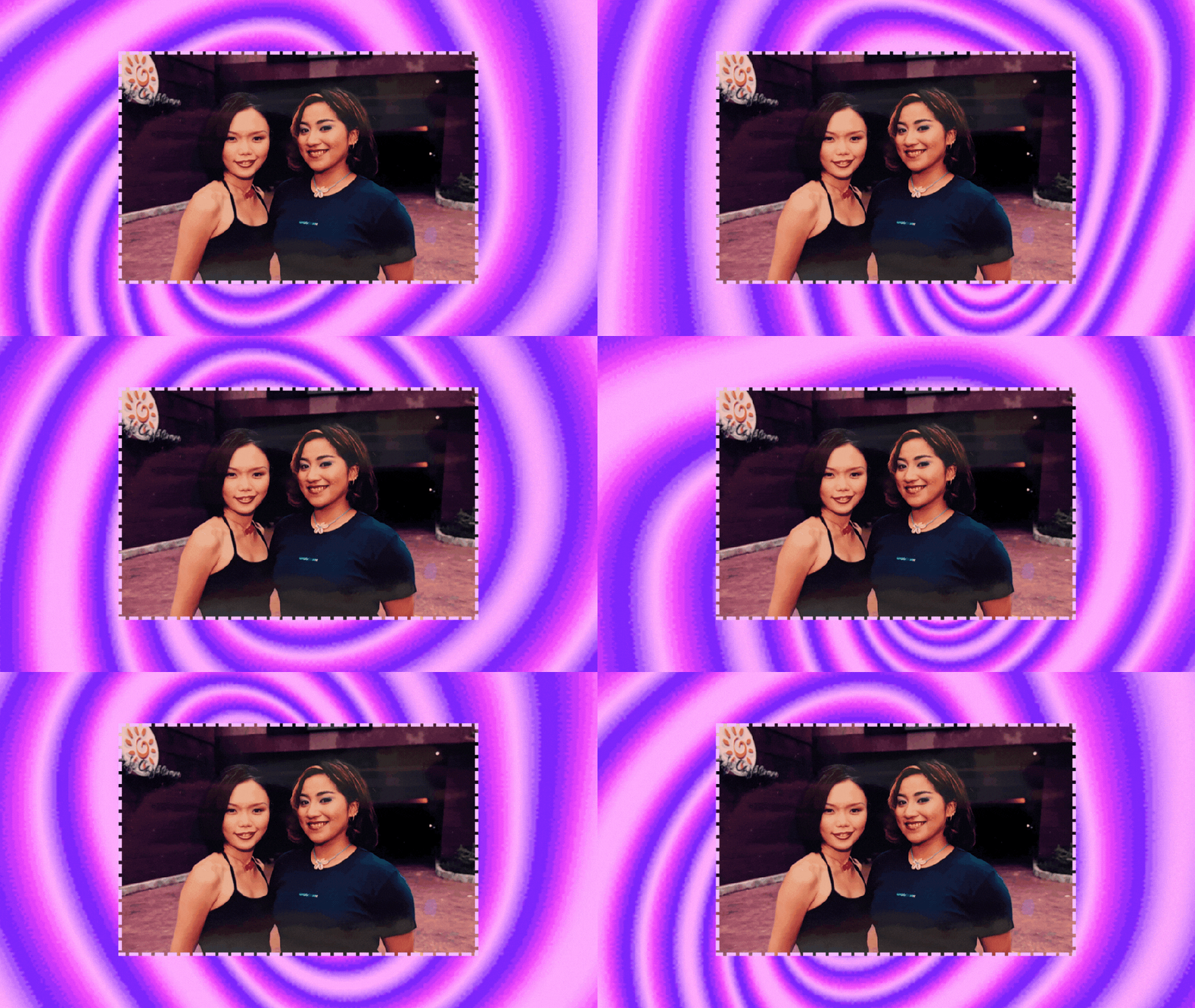
I was born in 2001, the year Juliet The Orange disbanded. Before disbanding though, the indie pop duo were releasing music under the renowned label, Positive Tone, joining when they were just 18. Intrigued by their image and band name, I spent a Sunday googling them. It felt like stumbling upon an offbeat treasure trove — a little campy, a little theatrical, very melodramatic. Watching their music video for “Eyelash”, I wondered if they enjoyed Kate Bush music videos too. Finding their songs was not as difficult as I had anticipated. Several of them were on YouTube under their official account, a few uploaded from random accounts and one on SoundCloud from an unknown user. A microcosm of the state of digitally archived Malaysian music pre- and early 2000s. A little here and a little there, if we’re lucky.
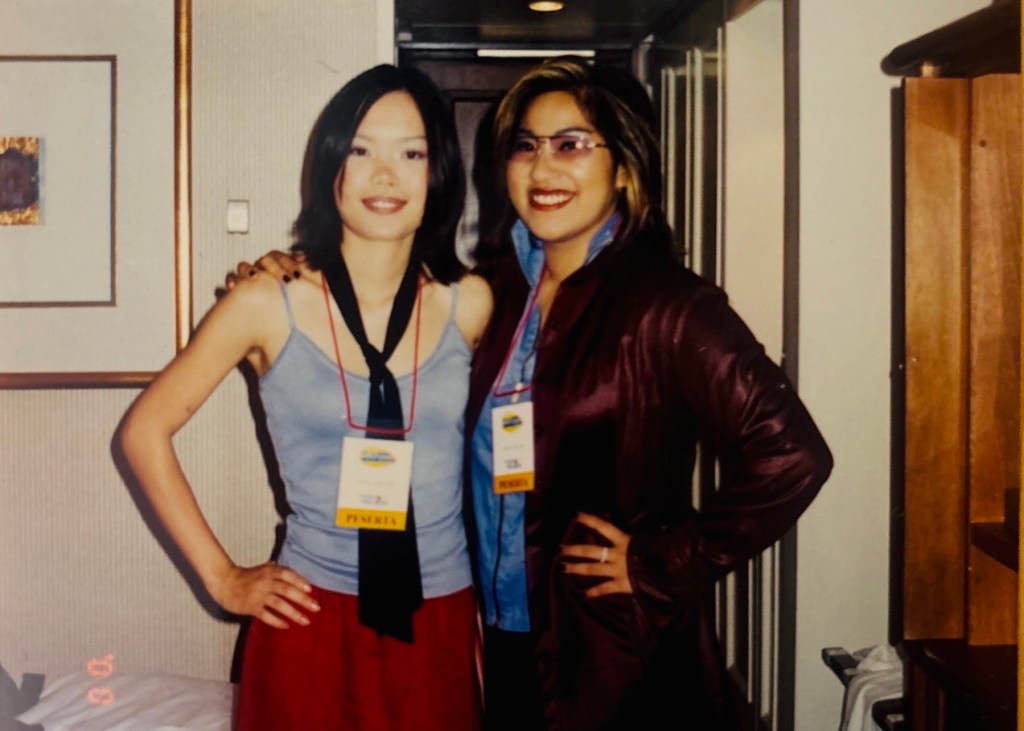
Pin Lean Lau and Lam Mei May of Juliet The Orange are now a lawyer and banker respectively. Before launching into these “second” careers, they were releasing music as a duo under Positive Tone and were active between 1996 to 2001. They gained prominence after releasing their song “Ode From a Psychopath” initially as Brodwyn, for the label’s compilation album Boys & Girls 1+1=3 (1996). They went on to release their successful album Juliet The Orange, which earned them the Best New English Artist award at the 7th Anugerah Industri Muzik. The headline read “Juliet The Orange tewaskan artis lelaki”, deftly capturing the uniqueness of their music and being a female duo at the time.
During the interview, they told me that they were excited that someone was still interested in their music after all these years. I reminded them that there’s still a small corner on YouTube of people listening, commenting under their videos on the “better days” of music and asking “Who’s still here?” to the room. Over an hour and half on Zoom, we talked about this nostalgia in current tastes, longing for a time that’s not now, and what it was like making music back then, which funnily enough, feels new to me. This interview has been edited for brevity and clarity.
S: So where are you both calling from?
Pin Lean: I moved back to KL, two months ago, from London. Before that I was living in Switzerland and Hungary. Yeah, I’ve been away from home for like 10 years now. I’ve come back this year for an indefinite period of time.
May: I’ve always been in Klang Valley.
S: Are you both still in music?
May: I’m not. I have a full-time bank job and it’s a pretty boring job, but it takes up a lot of my time. So, no, I’m not active in music anymore. My father was never supportive of, you know, the music so-called “career”. So he was telling me that, you know, “You need to stop doing this and get a proper job”.
Pin Lean: I’ve had a similar trajectory to May as well. I was told that I had to get a professional job. Like I was doing Law and I was doing my bar exams when we were starting out, you know? And so I had to move into that space as well. And it was only after some time that I thought to myself you know what? I’m going to make music because I still love it for myself. I don’t need it to be a career. I just need it as a creative, expressive outlet for myself.
S: So how did Juliet The Orange come together then?
May: Actually, sometimes when I look back and I have to ask myself, how did that actually happen? Pin Lean and I were classmates for the longest time. During our sekolah kebangsaan time, we would sit ourselves in the back, and we would write. And we would call each other up on our landlines. And then Pin Lean approached Positive Tone. I think she wrote to them and they happened to have a slot because they were making a compilation album of some indie acts. And then they took one of our songs in. And then they liked what we had and decided to do a full album for us.
Pin Lean: Yeah, when I contacted Positive Tone, they were like, “Are you musicians? Do you want to record?” I was like, no, we’re just schoolgirls and we just want to record our music. They were like, “Oh, what does your music sound like?” And we were like, well, kind of indie folk, kind of girly pop. And they said, “Can you send us a sample?” And I’m like, it’s very bad quality. They’re like, “We don’t care”. So we sent it and they were like, “We want you in this compilation album.” And May and I were like, what the fuck happened?
S: So would you consider Juliet The Orange as part of the indie music scene at that time?
[Both laugh]
Pin Lean: I mean, I’d like to think that. I think yes. I think we’re kind of shy about it, but also, it’s like a very woman imposter syndrome kind of thing, right? Like, were we really that defining at one point? And actually, if I’d like to be very objective, I said, I think we were.
May: I happened to bump into Tasha Logan, the daughter of one of the Alley Cats’ lead singers. We happened to be at the same event. And when she found out that I was one half of Juliet The Orange, she came and she jumped right next to me and she went, “Legend!”. And she took a selfie. So, yeah, I think, perhaps we were that defining then, in that era. And one more thing! I think Pin Lean, you would share the same experience as well. It’s a very proud moment for me when my daughter comes back from school and says “I told my classmate that my mom was a rock star.” And, I think it was very cool for my daughter to be able to say that.
Pin Lean: I mean, I’m very lucky. My daughter is very proud of me. She did the same thing. She told her friends, you know, and they listened. And I thought, oh my goodness, this is my daughter’s peers thinking that we’re cool!
S: While we were on the topic of the music scene back then, I think we have these fragments of what it was like because for us who have not lived through it, we can only reconstruct it through what’s left, what’s been recorded. So can you maybe describe what the backdrop to Juliet The Orange was like?
May: My memory of that period was I think we were very much together because there were a few other artists that signed with Positive Tone. We had our bandmates: John’s Mistress, Poetic Ammo. I think we were kind of always together when it came to touring. We did a Hotlink-Maxis tour where we got a chance to visit several states to perform there. So, that’s basically what little is left of my memory of that period of time.
Pin Lean: If I’m being really honest, I think we were sort of in a bubble. In that bubble of emerging indie acts that were coming up that was actually, I think, quite separate from the traditional music scene in Malaysia. So you have your powerhouse bands in Malaysia, rock bands, the ballad powerhouses like Siti Nurhaliza and Dayang Nurfaizah. I felt that we were quite removed from [the mainstream powerhouses]. It was the late 90s when you saw more emerging people like ourselves coming out singing in English instead of Malay, for instance. So I agree with everything May has said — we had band mates and all and people who were sort of emerging as well with us at that time. So we felt very homely, and I think in a way, we were quite sheltered. So I don’t feel like I have the actual knowledge of what the landscape really was at that point of time. And if I’m being honest, when we did go to events that were more sort of mainstream, I felt that disconnect. I’m not saying it’s a bad thing. I’m just saying it was different.
S: So coming from your experience being “sheltered”, what would you say about your experience navigating the music industry specifically as a female duo then?
May: I just felt that this entire concept of two girls singing and writing in English was something that was pretty new. And I thought that for a moment, the industry and the media didn’t know how to receive us. But I think at the same time, they also thought that it was refreshing.
Pin Lean: Coming back to the fact that it was Positive Tone, it was an independent music label that had very different visions on the music scene. So all these could be contributory towards that fact of why it was refreshing, why it was a novelty.
S: Cool! So I have been hearing a lot about Positive Tone from our conversation so far. What was it like being with such a small yet unique label?
May: We had a lot of support. We didn’t know much, because we were so naive back then and all that. But I think people like Ahmad Izam Omar, Paul Moss and the entire team there, were very supportive of us.
Pin Lean: Everybody at the label was actually super nice and they were very understanding. And I’m actually still in touch with so many of them. So basically, really fantastic people, Shameeta. And for a small label, maybe it’s to be expected? But I think what the vision was for Positive Tone was to be a label where your voices are really heard. I feel that we weren’t treated simply as products, but we were valued for what we could bring to the table. It didn’t feel like they saw us as a money-making venture.
S: Do you think the label viewing you as not just a money making venture, but really valuing your inputs and your creativity allowed you to kind of just do whatever you wanted to do?
May: I think it felt like that for me. And like what Pin Lean was saying, they were very supportive.
We weren’t treated like a product. There was a lot of consultation done when it comes to how we saw our music and how we wanted to express it. There was a lot of support as well in terms of how we could actually enhance the lyrics and the sound of our creations.
Pin Lean: I felt personally that [the label] were just looking for a different kind of a sound and willing to experiment and willing to give an opportunity to people like us, basically.
S: That’s really nice to hear! Though, there was a merger later on with EMI. When EMI bought the label, did that impact the direction of your music careers?
May: I think the opportunities got a lot more interesting. You’re part of a bigger network. We started to see that there were other artists from, you know, from Hong Kong, Taiwan, even Singapore. So we got a chance to meet Elva Hsiao.
Pin Lean: Yeah. Obviously EMI being an international label in that sense, the resource allocation was much more significant. But if we had continued, I think some things would have had to give if I’m being honest. I’m not saying that they wouldn’t have respected our values, but I think they might have wanted us to go mainstream a little bit more. There were times when I did feel when we put on some shows and all, [they asked] “Oh, why don’t you do this? Why don’t you do that?”. But that’s not our style. And they were like, “Yeah, but that’s more mainstream.” But we’re not mainstream.
May: I think I remember they wanted us to dance right?
Pin Lean: Yeah, they wanted us to dance on stage. And we’re not the dancing kind! But maybe if we had stayed on longer, we might have adapted to a point that would not compromise our values, but at the same time, maybe up our performance. I suppose at some point you have to think about the trajectory of your music, how much of it you want to retain, and how much of it you can compromise to attract a different kind of demography.
S: I agree, and it’s nice to hear that EMI did not force too much onto your very distinct vision for the music. I’m curious, who are your influences for your music, whether with the sound or visually?
May: Back then, I listened to a lot of Tori Amos. I love her music. I think she’s phenomenal.
Pin Lean: Cocteau Twins! I still love Tori Amos. There were others that I loved, but didn’t really translate into my music, like Garbage, Veruca, The Cranberries. Visually I like the whole Tori Amos image. Boys for Pele was one of her albums that I love the most. And the entire visual of the album is gray, sort of volcano-y and I kind of like that visual for the “Eyelash” music video, which is why you see that sort of very gray dark tone. I’m still at this age, still very drawn to that dark visual imagery.
May: Yes, I think we were very aligned in terms of what visual output we wanted. Some of the music was actually quite folksy and all that. After that, it evolved into this darker concept. Very creative as well. So we also liked that a lot.
S: That’s so cool to hear the influences behind the projects! Looking back and where you’re at now, has your relationship to music changed over the past 25 years, and how so?
May: Is it okay for me to say that these days, I don’t really listen to secular music that much? [laughs] But whatever music that I consume these days is through my daughters, because I’m interested to know what they’re listening to. I find that I am drawn to music that is a bit more ethereal, you know, do you call that ‘Bedroom Pop’ now? Not (many) instruments, you don’t hear much, but there’s a lot of vocals. And I think I was to ever go back to music, I think this would be a nice genre to get into.
Pin Lean: I like that you said that because when I made my EP in 2020, that was kind of the feel that I had in mind. If you listen to my first single from the EP, I wouldn’t call it ‘Bedroom Pop’, but I would call it experimental electronica, but dark. It’s called ‘The Alien in My Bed’. And so my music has changed significantly from the very folky, alternative kind of way. I think my lyrical sort of journey has also evolved. I think it’s become more raw and powerful now. I listened to a lot of very mainstream stuff because of my daughter as well. But at the same time, when my kid was growing up, she was listening to stuff like Deep Purple, Jimi Hendrix, Miles Davis, Guns N’ Roses. A lot of the music that I do listen to now, I see it more as like sounds and I treat music as something very healing.
S: And is there anything from your time as a duo that still remained, and guides you currently?
May: I think for me, it’s to believe that anything is possible. Back and even now. And I think for everyone, I mean, what I like to say is that never stop dreaming and, you know, anything is possible. I mean, we were just two ordinary girls, right.
Pin Lean: I think for me, creativity. That was always inside [which] came out through the music, and through my work in a professional way. Over the last few years, I’ve done my own projects that are, I think, very out there as well. I’m currently on a project on having artificial pregnancies in space. And I’m working on healthcare in the metaverse. So I think the creativity that I had as an artist has actually translated in some way to my professional work as well.
S: And just to round off this conversation of ‘back then versus now’, there’s sometimes this sentiment of nostalgia among younger folks for the previous eras of Malaysian music. What do you make of that nostalgia, and do you think it’s a romanticised perspective of music ‘back then’?
Pin Lean: I think every generation says the same thing. “Oh, things were better back then”. So I think it’s really a question of perspective and narratives and also the sort of environment that we grew up in. I think we need to think about how we define what’s better. So I think maybe there is that little bit of romanticising, that nostalgia. And because we’ve seen so much right now, we’ve all been introduced with sort of new ideas and new complexities. I guess it comes down to the kind of perspectives that we prioritise and what we would think is also better at that point of time. So maybe the real inquiry isn’t whether music then was actually better, but how we construct our narratives about what we see as music and what it brings us at that point of time. Because I’ve asked myself this question many times, right? People say things like, “Oh, it’s just better in those days.” Yeah, but I think it’s all a question of construct. It’s a question of narratives.
S: I like that approach, a bit more of a nuanced take on this topic. Because it’s just a matter of what you’re looking for in music. On current acts, are there any Malaysian acts that you would like to shout out?
May: Recently, I stumbled upon music by this local group, Faye Faire. I think they are a four or five piece local band. And I found the music pretty, you know. It’s very indie, it’s very folksy, it’s very alternative, the kind of sound that I enjoy listening to. And I think I might explore the entire album.
Pin Lean: To be honest, I’m not very in with the local music scene, like literally, because, you know, I’ve been away for so long. But I remember when I was still in Malaysia, there was this sort of electronica duo that I really liked, the vocals plus the sounds that they were making. They were called +2DB. Kyoto Protocol, I love, so I will recommend Kyoto Protocol. And recently, I came across Heidi Moru. Her vocals are brilliant! So beautiful it makes you feel things.
Shameeta is a casual writer from Ipoh. Her interests are (surprise,surprise) music, and is currently enjoying surfing through online archives of music from the past. Besides music, she enjoys designing posters and watching EXP TV.
 noisy headspace
Leave a reply to Juliet The Orange Didn’t Need Forever – bjorn2dye Cancel reply