
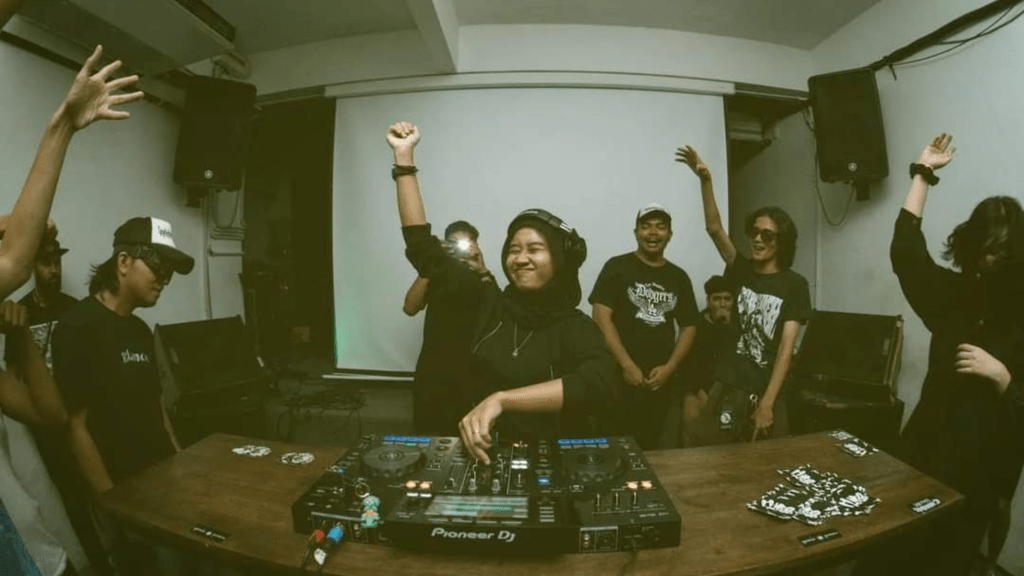
If you squint hard enough at the contentious Pestapora official poster (bright pink background + white text = pening kepala), you’ll notice just two Malaysian names on it. First, there’s the legendary Dato’ Sri Siti Nurhaliza, who has had a devoted Indonesian fanbase since the early 2000s. And then there’s Miko Naiko — a 26-year-old DJ from Ipoh making her biggest-stage debut yet.
It’s hard to miss Miko when she’s on the decks. Her name has slowly risen in a scene still largely dominated by men — a struggle even international stars like Peggy Gou contend with. But Miko, real name Sharifah Syauqina, stands out in more ways than one. She’s a hijabi DJ, usually clad in black, performing acid house and hard-edged techno to crowds mostly made up of men at hip-hop and hardcore afterparties. We don’t have many hijabi DJs in Malaysia, perhaps because the DJ label often comes with outdated, loaded stereotypes. Add to that the social pressure of being a hijabi in the public eye, and it becomes even harder. But Miko persists, regardless.
She fell in love with electronic music at 15, diving deep into Tomorrowland sets and teaching herself how to mix. At 18, fresh out of school, she bought her first deck and a year later, performed for the first time at a hip-hop gig in Ipoh. It was nerve-wracking, she admits but that moment opened doors. She went on to perform at more afterparties, making her festival debut at Atas Angin last year, toured across Malaysia and Singapore and even producing her first experimental noise track with Indonesian collaborators.
In May, she quietly locked in a slot for the second day of Pestapora — a secret she kept until the lineup was officially announced in July. I spoke to Miko upon hearing the news of her Pestapora debut. With more acts still to be announced (over 230, if you’re counting), she currently remains one of only two Malaysian performers on the bill. For Miko, this moment is as massive as it is meaningful. And for anyone watching from here, it’s easy to become a fan. This interview has been edited and condensed for clarity.
Farhira: First of all, congrats on landing a spot at Pestapora! That’s huge. How do you feel about it?
Miko: Thank you! It’s a mix of emotions honestly. Excited, but nervous too. (laughs) It feels like I’m kind of representing Malaysia over there, you know?
Farhira: Which stage are you on?
Miko: If I’m not mistaken, there are a few stages, and each one is curated by different organisers. So I’ll be performing on the one curated by Yes No Klub. It’s run by an Indonesian artist and curator named Wok The Rock.
Farhira: So he’s the one who invited you?
Miko: Sort of. He actually reached out to a Southeast Asian platform called Align Online SEA. I got to know them last December when I was a guest on their radio series. They sent DJs to Pestapora last year too, and this year when the organiser asked them to recommend someone, they picked me.
Farhira: Let’s start with the basics. How did you first get interested in DJing?
Miko: From around standard 6, I was already deep into all that mainstream DJ stuff like watching Tomorrowland sets on YouTube. And then I started teaching myself to mix when I was 15. I watched tutorials, studied how other DJs did their sets. All self-taught. At the time, the DJ scene in Malaysia felt really limited, especially outside of clubbing. So I thought, why don’t we have something more public and accessible? That’s part of why I started DJing. These days, it’s cool to see DJs performing in cafés and thrift stores, not just clubs and bars.
Farhira: What did you use to practice back then? Did you already have a deck?
Miko: At first, I was just using DJ software on my laptop. Then after SPM, I finally got my first deck. I wanted to save up for it myself, but my parents ended up buying it for me. They saw how focused I was for four or five years, and they knew I was really serious about it.
Farhira: That’s amazing. So your family’s been your biggest support?
Miko: Yeah, definitely. My family comes from an arts background. My mom used to curate art exhibitions because she’s an artist too. So they understand how the underground scene works. That helped a lot.

Farhira: So when did you start performing?
Miko: In 2018. I was 19 and I finally had the courage to perform. Before that, I’d just upload mixes to YouTube.
Farhira: What gave you the confidence to perform live?
Miko: Honestly, my friends. A lot of them were organisers in the underground scene. They’d invite me to play and show up to support me too. That really helped. My first gig was a hip-hop underground event in Ipoh.
Farhira: Were you nervous?
Miko: Super nervous. My hands were shaking! (laughs) I was scared people would judge me, seeing a girl wearing a hijab behind the decks. Some people were surprised because they’re not used to it, and some gave me constructive feedback. Over time, I met more DJs and learned a lot from them.
Farhira: Do you feel there’s pressure being a hijabi DJ?
Miko: Back then, yeah, it did mess with my head a bit. But I see it the same way I see any instrument except my setup is an electronic instrument. People have this mindset that DJing is tied to partying or bad behaviour, but for me, it’s just about the music. I don’t take any substance, but I still feel the adrenaline. It’s how I express myself.
Farhira: What kind of music did you grow up listening to?
Miko: R & B and pop mostly. Ipoh also has a strong indie scene, so I was into bands like Hujan who performed several times in Ipoh. I only got properly into electronic music after discovering it through social media.
Farhira: What drew you to electronic music in particular?
Miko: Freedom. You’re in control of the sound, layering and mixing different elements to create something new. It’s experimental. It’s you.

Farhira: How did you develop your taste?
Miko: At first, I’d just watch sets from DJs at big festivals, then go dig deeper. I’d listen to their sound, read about the subgenres. That’s how I discovered people like Nina Kraviz, a Russian DJ who plays and produces techno. I love her sound.
Farhira: Your bio says you’re “anti-genre-ism.” What does that mean to you?
Miko: It means I don’t limit myself to one genre. Some people are really strict about their sound and don’t want to mix styles. But for me, I think we should embrace all kinds of music.
Farhira: In 2020, you did a track called “Nepacirna Ijaw” for Pancawala split EP with Indonesian artists. That one had a darker ambient sound. Can you tell us about that?
Miko: That happened during a small tour I did with some Indonesian friends. We played experimental and noise gigs in Ipoh, Penang, and Singapore. It wasn’t as a DJ, it was more as an experimental artist. I didn’t have any experience in that genre, but my friend Rio Nurkholis encouraged me to try. We ended up doing a split EP together, and that was the first track I ever produced.
Farhira: Do you find producing a challenging work?
Miko: Definitely. If you’re a perfectionist, it’s tough. You doubt yourself a lot, you feel like it’s not good enough, so you don’t release it. It takes time to build confidence with production.
Farhira: And considering you hadn’t done experimental or noise music before, how did you approach it?
Miko: I just focused on telling a story through sound. The track was kind of a soul-searching journey. Some parts were ambient, others more chaotic. That’s how I see experimenting with music, by pushing what you feel into sound.
Farhira: Is there anyone in the scene you really look up to?
Miko: rEmPiT g0dDe$$. She’s actually the one who reached out to me on behalf of the organiser for Pestapora because she played there last year. She’s been super supportive and has helped connect me to opportunities. Last year I was a guest on her radio show in collaboration with Hong Kong Community Radio. It was my first time being exposed to an international platform. Her sound is experimental, but still super listenable. I really look up to her.

Farhira: Ipoh is known as the City of Music. How has the scene there supported you?
Miko: The DJ scene in Ipoh is still quite small. It’s more focused on hardcore and indie right now. But I’ve been invited to spin at afterparties for hardcore gigs. It’s tough to draw a crowd for DJ-only shows, so we try to combine scenes.
Farhira: How are you preparing for Pestapora?
Miko: I’m working on producing some original tracks. Hopefully I’ll be able to debut them at Pestapora. My goal is to have at least three new songs ready by September.
Farhira: You’ve been DJing for almost 10 years now. What’s the biggest lesson you’ve learned?
Miko: As a female DJ, people often say things like, “She just dresses nice, but her sound isn’t great.” That kind of stuff. But for me, it’s not about how you look. It’s about your skill. I’ve learned to block out the noise and just focus on improving.


 noisy headspace
Leave a reply to JUICE Best Of 2025: Your Year In Bangers, Ballads & Boundary-Pushers – Hamara media Fun Cancel reply