
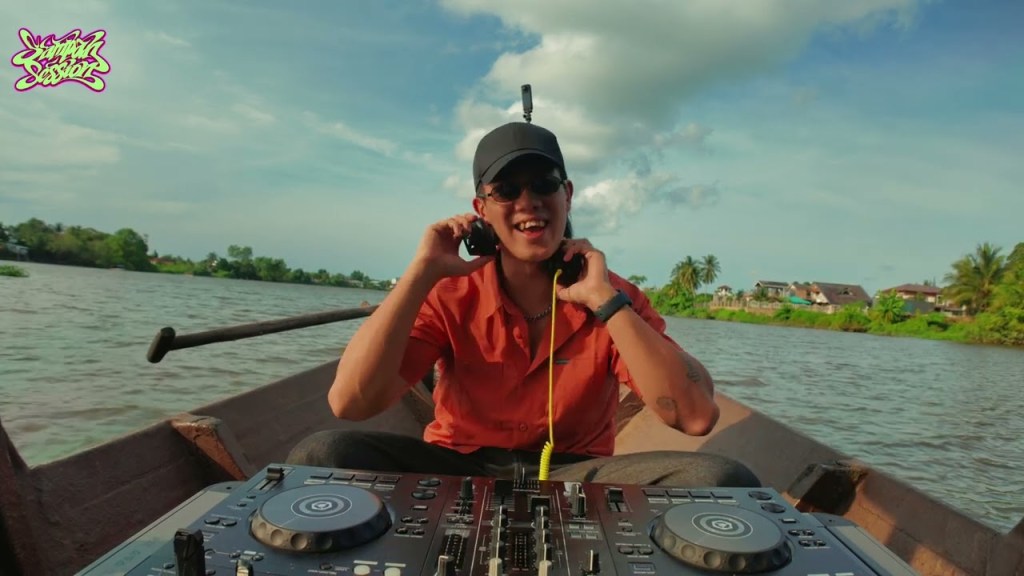
From our one-hour long conversation, Sampan Sessions — a music series filmed on a traditional sampan boat on the Sarawak river — is quietly trying to do a few things at once. It wants to give musicians a platform free from the expectation of fitting a particular sound. It wants to nudge people toward discovering Sarawak. And it wants to recapture the feeling of starting a music project with no rules and no pressure. With all of that in mind, going viral — despite the undeniably viral-worthy setting — has never really been the point. If anything, its founders Morgan Then and Kiyoshi Aihara seem allergic to that kind of attention.
The two behind it are long-time friends who’ve spent years embedded in the music industry. Morgan is one half of the Australian electronic music duo SLUMBERJACK. Kiyoshi — or Keeyushee and Yosh, to most — is a DJ who has been shaping the Kuching music scene for nearly a decade. But Sampan Sessions doesn’t carry the weight of a serious business venture angling to be the next big thing. Instead, it’s closer to an extra curricular activity you do for fun and end up loving more than the main gig.
The first episode went up in March, though the idea had been floating around for nearly a year before that. It survived the tabling, the scheduling conflicts and the country’s busiest season before Morgan and Yosh finally pushed through and shot it. With just the two of them and an easy-going sampan uncle, they built the whole thing themselves. The setup, by their own admission, is held together mostly by duct tape. A far cry from SLUMBERJACK, Morgan claims, where there’s a proper budget and a crew — here, they were borrowing equipment from friends and sticking it all down however they could.
“It was cowboy as hell,” said Morgan.
But DIY has a way of humbling you. In your head, your excitement tends to cloud your judgement. In practice, things fall apart easier than you’d expect. Though both their sets were filmed on the same day, only Morgan’s made it out. Yosh’s is still sitting on a shelf because under the scorching force of the Malaysian sun, sitting on the iconic water taxi and playing a mix turned out to be something close to torture.
“When Morgan sent me the final cut, I’m just like “I’m not putting mine out.” It went so bad,” Yosh said.
And yet, they keep going. They have released two episodes so far, with plans for more sets and even more experiments. After years in the industry, the duo admit that building something from scratch without the budgets and the infrastructure feels like getting back to the point of it all. I spoke with Morgan and Yosh about their DIY process and what it’s like to start a grassroots music project in the age of the attention economy. Spoiler: it’s nowhere near easy. But it’s always going to be worth it.
This interview has been condensed and edited for clarity.
Farhira: I discovered Sampan Sessions just a few days before I DM’d you on Instagram, and I was immediately intrigued. I think it might be the first time I’ve seen someone DJ in such an unconventional setting here in Malaysia. Overseas, you see that kind of thing in grocery stores and places like that, but this feels like it takes it to a whole new level. So what sparked the idea, and who started it?
Yosh: It started because we were bored, man. Morgan lives in Australia so when he came back to Kuching for a couple of months, we wanted to do something together. I do events and stuff, but I’d been feeling uninspired by the local scene. So one day I was just sitting there typing ideas in my notes, and I wrote down ‘DJ on a sampan.’ Two weeks later, out of nowhere, Morgan hit me up and before he could even finish, I just asked, ‘You want to DJ on a sampan?’ He replied, ‘How the fuck do you know?’” It was crazy.
Morgan: I felt like we had real talent here worth capturing especially since friends of mine from Australia would sometimes stop by Kuching or KL between tours. With Sampan Sessions, we can now actually entice artists to make the trip, because for someone already stopping through KL or Singapore, Kuching is arguably a cheaper and quieter alternative. We also just wanted to do something that felt true to this place. We were tired of the usual DJ pop-ups at cafes and libraries, and a sampan made sense because it’s a legitimate mode of transport in Sarawak. And since it’s just the two of us, we could keep it grassroots. We didn’t want it to feel like something that needed to go through layers of approval. We just wanted to make it and put it out.
Y: Before we actually got a sampan and started shooting like the first episode, I asked around if anyone had the contact for a sampan uncle. And they all laughed at me, man. I didn’t tell them exactly what. So we kept it hush hush because when you have a great idea, once you share it with one person, they might steal it and they might do it.
F: What does the Sarawak river mean to you guys personally beyond just being a setting for the sampan session?
Y: I grew up in Kuching so it’s always just been there. My mom used to work for the Sarawak Tourism Association and her office is right by the waterfront. I spent a lot of time around there as a kid, maybe 10, 11 years old, just playing around.
M: For me the river is just this great mascot of Sarawak. When my foreign friends visit and ask if they can swim in it, I’m like “You could probably do it once.” (laughs) It’s infested with crocs, which I think is super gangster. But also there’s something meaningful about taking something so modern like electronic music and playing it on this ancient mode of transport, on a river that’s been there since before our great, great grandparents. A lot of people in Sarawak take it for granted because we see it every day but being out there on the sampan, we realised how much we actually do. The sunset was beautiful, man. It’s nice.
F: Was the sunset timing intentional?
M: I mean, we don’t have a professional lighting crew, so the golden hour does that for us naturally. And then, imagine shooting at noon in that heat with zero shade. We’re fully exposed out there, so we have to watch out for ourselves and our guests.
F: What was the sampan uncle’s reaction when you explained what you were doing?
Y: (laughs) He is the type of guy that gives zero fucks. He was probably like “Okay, just a bunch of kids DJing on the boat.” He was sitting at the back and smoking a cigarette. Just doing his own thing.
F: When it comes to the music, do you have specific considerations for what you platform on Sampan Sessions?
M: No, I don’t believe in that. Yosh and I came up as just two kids doing our own thing with no interest in playing clubs or local establishments. All the other kids were DJing with the goal of getting booked at those spots, which means playing to a specific playlist because that’s what the general crowd wants. But we always played completely our own stuff. So I never believed in booking a DJ and then telling them what to play. If you book someone, you’re saying you trust their taste. Why tell them what to do after that? That’s not how art works. Whatever you want to bring to the table, as long as the curation is dope and the vibe is there, you’re welcome on the sampan anytime.
Y: I mean, it’s also a form of expression, right? Like, as a DJ, you love all types of music. So, we’re not gonna tell you “Since you’re playing during sunset, so you gotta play house music.” If you want to play dangdut, go for it, bro.
F: Since you’re open to any kind of music, is there a specific act or genre you dream of having on Sampan Sessions?
M: Before DJing I was doing electronic live looping sessions — basically what Fred Again does. That would be really cool to see on the sampan. But also just a 30 minute acoustic session would be even more special. That’d take Sampan Sessions outside of electronic music and make it a music platform.
Y: Not gonna lie, I would love to see a syair recital on the sampan. Just one guy singing it, but with a beat. That would be so amazing.
M: I think the only thing I would be more apprehensive about would be weeding out the pretenders from the real ones. Cause the music industry is so saturated now, right? There’s a lot of DJs now. And I’m not trying to gatekeep music at all. I think everybody should have a good crack at, you know, music, but there are a lot of people that just want to do it because they think it’s a cool thing, which I find completely fine. But if you stay in it too long and not want to do it, I think I can smell it.
Y: You know, we had to go through the trenches to get to this point. At one point people, the OGs thought we were trash, and we took that comment and we were like, okay, maybe we were trash. So let me work on my craft and then slowly build my work. You take the L’s and then you learn. My issue with the DJs now is that they don’t go through the trenches. All they have to do is have a camera and a controller that’s super affordable. They’ll have some crazy lights, some nice background. Put it on YouTube or put it on social media, you blow up, and that’s it, like, you’re it. You’re the shit. But they’ve never played in front of a real crowd. They cannot handle it.
F: When you say new DJs need to go through the trenches, what does that actually mean?
M: There are two ways. You play a lot of events. So many that promoters are telling you what kind of music to play, you get bossed around, you learn how to do weddings, birthday parties. You don’t get to run underground shows. You play every single genre that keeps your business afloat. That’s the trenches. You do the things you don’t want to do to eventually get to do the things you want to do.
The second way, which is the way I did it, is that I didn’t DJ too much. After DJing in Kuching, I cut my teeth through writing and production when I moved to Australia. I produce electronic music, and when the music got good enough, I had to go back to learning how to DJ because it was the only medium to play out my own electronic songs. The new DJs now haven’t really cut their teeth because social media has given a very low barrier of entry to the music industry which I think is great. But also, it gives a very false sense of confidence. You think, I have a million people looking at my stuff, they really like me. Well, not really. The algorithm just happened to put you in front of a million people for about seven seconds. That’s very different from preparing for a show, going live, and getting your first boo or having someone come up to you and say, that set was mid.
F: It’s the same as every other art form in the social media age. The numbers can be high and still mean nothing. Social media gives you this false sense of confidence that reach equals quality.
M: Yeah, everything gets reduced to 15 seconds now. It’s a commodification of art.
F: So how do you try to stop Sampan Sessions from being reduced to just a 15 second clip?
M: Each video has nine to ten clips, and hopefully those funnel people to the long form video. One reason I was down for the idea is something I noticed when visiting friends who are millennials, who came from the party world, now have kids but are still cool, still partying. And I’d see them put mixes on the TV. Long form content is still being consumed, just in a different setting. We just need a funnel to get people there. Short form content is part of the game now, and I’m not going to pretend I won’t play it. This is our trenches. Doing what we don’t want to do to get to do the thing we actually want to do.
F: It’s a trend now to have musicians playing in unconventional spaces. On top of a mountain, in an elevator, in a grocery store. So many unconventional settings just to get attention and audience. But with that trend comes an audience that wants to be part of it. Like, they want to come, film their TikToks, show up to your shows just to make content. With Sampan Sessions though, there’s no live audience with you out there. Do you see that as a gain or a loss?
M: I see it as an exclusive gain. It’s exactly what sets this apart. We’re taking it back to the roots, playing just for you and your homies. If you want to be part of it, we need to start communicating. You gotta come and talk to us. What I hate is when people show up to an event, shoot their content, talk about it, but never actually promote the event. You’re just taking, not giving back to the community. So this is, I guess, a very subtle form of semi-gatekeeping. The boat can fit like, what, 10 people?
Y: I think the maximum is 20 people. But we’re not really looking to have like a whole crowd on the sampan.
F: Do you hope the audience engages more with the music itself, or the overall vibe? Because obviously DJing on a sampan in Sarawak is amazing in itself but would you want people to resonate with the music just as much?
M: Yeah, for sure. We might have to figure that part out, but as a startup, we just needed a minimum viable product to post and have talk about it. You never know.



Leave a Reply