
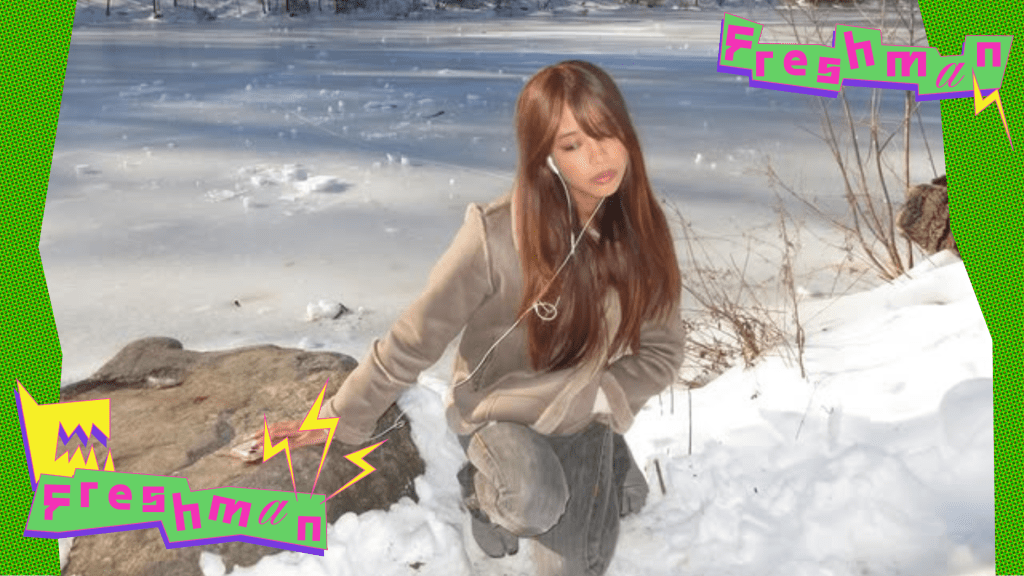
It’s 10:00 PM in New York City, a 12-hour difference from where I am in Kuala Lumpur. Natalya Swan is sitting in her bedroom. Sirens wail outside her window, and before we get started she gets up to close it so we can have a little more quiet. Behind her are two giant wall posters: one of the Sylvanian Families’ White Chocolate Rabbit, the other of Nana Osaki from the hit Japanese anime series NANA. Both loom large behind her, serving as unlikely guardians of the room.
When you watch her music visualizers, she projects the confidence of a ready-made pop star. Her music — a whimsical, Y2K-inspired strain of ethereal pop that feels descended from the worlds of Oklou and After, with singer-songwriter pen game — fits the sweet tooth we’ve developed for this kind of electronic pop. But Natalya is clearly a shy and sensitive person, a little removed from who she puts forward in her visualizers. This sensitivity is clear in “Swan Lake” where she laments her striving for perfection as a ballerina and the stage as a concept altogether. The introduction leaves heavy sighs on the struggle: “I’m so tired of the stage / Take the veil off my face / Will the lace hold my hand for longer?” and later in the song she explains her pursuit, perhaps self-aware that it’s eating her alive: “Not that I wanna please the crowd / Every girl has two swans underneath her / I’m running from my own reflection / And I don’t wanna dance without perfection,” she coos, the elegant, cloudy instruments built to cushion the blow.
Natalya grew up in Kuala Lumpur before moving to New York City to study psychology in 2021. Although she graduated last year, she has remained in the city to focus on music. Describing her career as still being in its very early stages, Natalya seems realistic in these infancy stages. If anything, she’s excited to explore her potential, attributing New York’s vibrant and supportive arts scene as her support system. Over Google Meet, we spoke about her music, being a sensitive person trying to make art in a big city that constantly demands more and what comes next. This interview has been edited and condensed for clarity.
Farhira: I discovered your music recently thanks to the Instagram algorithm and I was immediately intrigued. So could you tell me how you first got started in music?
Natalya: I think from a young age, there wasn’t a time where I didn’t want to make music, to be honest. I played the guitar and the piano growing up, and I was performing as well. That desire was always there from a really young age. But it wasn’t until the latter half of 2025 that I really sat down and decided to do it, which ended up being my first single. I’ve been surrounded by so many artists for the last four years, and especially at my school, there are a lot of really talented artists in film, music and every kind of medium. So I think that helped shift my mindset and made it feel like a possibility. Over time, I began to realise that this is what I wanted to do.
F: There’s a clear elegant electronic pop sonic throughline across all three releases. When and how did you decide that this was the kind of sound you wanted for your music?
N: I think because I grew up listening to pop music, it was always that direction to an extent. And then I think the hyperpop and more electronic side of things came later, which led me to listen to other artists like Oklou, who’s been really inspiring for me. I’m also just really into electronic music because of the amount of textures and sounds you can work with. It really helps me emotionally when I’m writing songs. So I think that part of it has been really fun and helpful for me to experiment with different sounds and see how that impacts my songwriting.
F: What kind of music were you listening to when you were growing up?
N: Pop artists, like classic 2000s stuff. Kelly Clarkson and Avril Lavigne. And then I had a really big One Direction phase after that.
F: Okay, same. So who was your favourite in One Direction?
N: Mine was Harry Styles. What about you?
F: I feel like I kept changing my mind though. Like I started with Liam, and then it was Niall and then it was Harry. So it kept changing.
N: (laughs) I feel like most people just stick to one member, but that’s cool that you kept switching.
F: So when you first started making music, how did collaborators respond to the sound you were going for? Did they get your vision immediately?
N: I primarily work with one producer, and we have very similar tastes and a shared vision of what my music would sound like from the start. I was really lucky because it made it super easy for us to work together.
F: You’ve released three songs so far. I’m curious to know which one is your favourite?
N: It’s a hard question. It changes. I think I’m most attached to my last release, “Musicflirte” but all of them are satisfying in their own ways, so it’s hard for me to pick a favourite.
F: I have a personal favourite. It’s your second single “Swan Lake” which emotion-wise, it really opens up your pursuit of perfection, though you also sound defeated by it. I assume you practised ballet as well. I’m curious about your relationship with it.
N: I think it’s pretty complicated. I was using that song, like you said, to talk about my tendency to strive for perfection, especially in ballet. I feel like, particularly when it comes to performing, it had a really big impact and made me have a kind of, I guess, toxic relationship with it. I was using it as a metaphor for my issues with performance anxiety in general. I was comparing my struggles with performing on stage to performing in everyday life as well like making really good music, doing well in school and so on. So it touches a lot of different parts of my life.
F: Do you still practise ballet?
N: I haven’t… Oh wait, actually I have started doing public classes again in the past few years, and I think doing it now, with some distance from how I experienced it as a child with a lot of pressure, has been a lot more freeing and a lot more fun.
F: Do you mind sharing where that pressure came from?
N: I think naturally I’ve always been a perfectionist in life. That’s very much been part of who I am across all aspects of my life, from my studies to my hobbies. Even now, I still struggle with it when it comes to music. Being a perfectionist and trying to strive for the perfect song, even though there isn’t really a perfect standard for that. So it’s always been there. I’ve definitely been trying to get over that.
F: I think that’s the essence of being a perfectionist or being forced into it. Growing up there are all these different pressures, and by the time you’re an adult you’ve just learned to live with them, for better or worse. But I think there’s still a lot of unlearning to do. Do you find yourself having to unlearn a lot of that? To free yourself from the pressure?
N: Yeah, for sure, I think I’m always trying to correct my mindset when I find myself being too perfectionistic about it, especially recently with music, Like, when I find myself putting too much pressure to make a song, I do try to tell myself to chill out a little bit and take a step back.
F: So how do you know when a song is finished? When are you satisfied with it?
N: Yeah, that’s a good question. I think that part is pretty instinctive, especially because all my songs so far have been made over a really long period of time. Like a couple of months. At least with the releases I’ve put out so far, I can always tell when there’s nothing else left to add, when it feels like it’s completed the original vision of what I set out to make. But it’s very much an instinctive thing, I think.
F: I find that there’s a lot of delicacy and shyness in your music. Have you ever felt like you needed to change that to fit yourself better in the scene, maybe in New York?
N: Yeah, definitely. I’ve felt that pressure to become more extroverted all throughout my childhood and growing up. Especially in the U.S, because people here are very extroverted and outgoing, so I’ve definitely felt the pressure to adapt. But I think recently, especially since I started making music, I’ve realised that it’s not necessarily something inherently bad. It actually helps me be more introspective, and it’s a big reason why my music sounds the way it does. I can’t really regret that, because it plays such a big role.
F: The thing about making music and putting it out online as an introvert is that there’s this massive gap between being alone in your room writing it and thousands of people suddenly streaming your music. As a shy person, that gap must feel overwhelming. How did you navigate that?
N: That’s a good question, because for some reason, even though I did grow up really shy, I’ve never really had trouble posting online. I don’t know if that makes sense, but I’ve always felt like it’s a place where I can really express who I am without being held back by social anxiety. So, in a way, I found it easier than if I had to perform live for, like, 100,000 people. Yeah.
F: Do you have plans, though, to perform live?
N: I definitely want to. Yeah, no, I would love to. I don’t have any plans yet just because I think I need more songs. And, I need to have to be able to build a set list, but definitely, I think that’s the next step that I want to take.
F: I wanna go back to your identity. How do you protect your sensitivity as a creative person in a world that constantly demands you to be more visible?
N: I think I just try not to think about it too much. When I’m making music, I try not to let what I think other people will think affect how I go about the creative process, because I feel like that can really interfere with your judgment when it comes to making decisions for a song. During the creative process, I try to really trust my instincts and my taste.
F: A lot of hyperpop is rooted in internet culture. Sometimes it feels like only people who are chronically online would really understand it. So how has the internet influenced your music, beyond just musical references?
N: Yeah, I grew up really involved in fandoms and stan culture. I had my One Direction phase, and I also got really into YouTubers, especially British YouTubers. Being involved in those online subcultures really shaped me. I was also into emo music such as My Chemical Romance and Panic! At The Disco. Being part of all these subcultures really helped ignite my passion for music and artists. It made me obsessed in a way that eventually led me to want to do it myself.
F: I love that answer. I grew up on the internet too, with maybe an unhealthy amount of screen time, but it also shaped me as a writer because you get to explore so many parts of the world without leaving your room. And I think your music reflects that too: being shy and introverted but also how the barrier is removed once you’re on the internet.
N: Yeah, definitely. It was very developmental for me. Being so obsessed with the internet helped shape my tastes and my individuality as a person.
F: How do you feel about TikTok and marketing your music? A lot of indie artists struggle with promoting themselves because it has to feel niche, visually appealing and reach the right audience. Do you find it a struggle or an advantage?
N: I’ve definitely been trying to use it to my advantage. I thought I would feel that pressure, but once I started coming up with visual ideas, I realised that as long as it feels true to me and representative of who I am, I don’t really have a problem with promoting it. It actually feels sincere. So in that way, it’s been creatively freeing for me.
F: Are numbers important to you? Streaming, views, all of that?
N: Not really. I try not to put too much pressure on that. Of course I’m really grateful when people connect to it, but I try not to think about numbers when I’m creating. As long as I’m happy with the music and visuals I’m making, I’m happy.
 noisy headspace
Leave a comment